- This topic is empty.
-
AuthorPosts
-
17/06/2026 at 17:58 #11414
Why Agricultural Spraying Drones Demand Superior Propulsion Systems
Agricultural pest control operations represent one of the most demanding applications for unmanned aerial vehicles. When spraying systems carry multiple gallons of pesticides, herbicides, or fertilizers, the drone’s propulsion system faces extraordinary challenges: maintaining stable flight under constantly shifting payloads, generating sufficient thrust for takeoff with heavy equipment, and operating continuously throughout extended field operations. For agricultural service companies, propeller performance directly impacts operational efficiency, treatment coverage accuracy, and ultimately, profitability.
The fundamental challenge in agricultural drone operations stems from payload dynamics. Unlike inspection or photography drones that maintain consistent weight throughout flight, spraying systems begin missions at maximum weight and gradually lighten as liquid is dispersed. This weight variation demands propellers that deliver stable thrust across a wide operational range while managing thermal loads during prolonged hovering and low-altitude maneuvering over crop fields.
The Three-Blade Aerodynamic Advantage in Agricultural Applications
Traditional two-blade propellers have long dominated the consumer drone market, but agricultural applications reveal their limitations. When carrying spraying equipment weighing several kilograms, two-blade configurations require higher rotational speeds to generate adequate thrust, resulting in increased motor temperatures, elevated power consumption, and pronounced flight vibration that can compromise spray pattern precision.
Three-blade propeller designs address these agricultural-specific challenges through fundamental aerodynamic principles. By distributing thrust generation across three surfaces rather than two, these propellers interact with a larger air mass per rotation. This expanded air interaction area produces more stable thrust at lower rotational speeds, reducing the mechanical stress on motors and electronic speed controllers while decreasing energy consumption per unit of thrust generated.
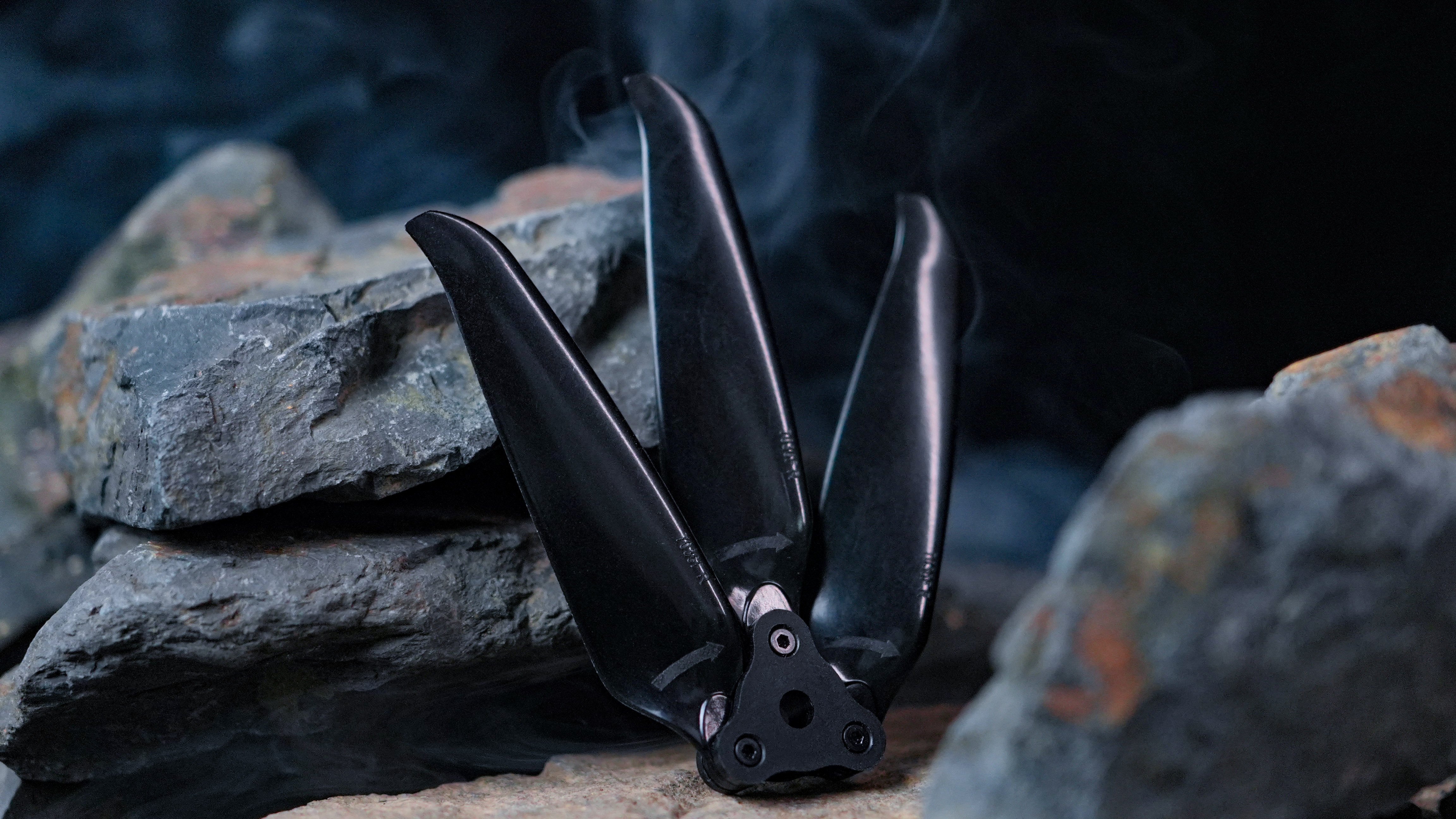
For agricultural operations, this translates into tangible operational benefits. Lower motor temperatures extend component lifespan in dusty field environments. Reduced vibration improves spray droplet uniformity and GPS positioning accuracy. Decreased power consumption extends flight time, allowing coverage of larger treatment areas per battery charge or fuel tank.
Engineering Specifications That Match Agricultural Workloads
GEMFAN, a manufacturer with 15 years of specialization in UAV propulsion systems, has developed propeller solutions specifically calibrated for agricultural platform requirements. Their approach centers on matching propeller specifications to the weight classes and operational profiles typical of spraying applications.
The company’s large-wheelbase three-blade series addresses the 9-13 kilogram takeoff weight range that encompasses most professional agricultural drones. The 16X8X3 model, with its 406.4mm diameter and 84.9g weight, targets 650mm-class platforms in the 9-12kg category. This specification provides powerful thrust reserves for initial takeoff when spray tanks are full, while maintaining efficiency during the latter portions of missions as payload weight decreases.
For heavier agricultural configurations, the 18X10X3 propeller extends capability to 13kg takeoff weights on 1300mm wheelbase platforms. The 457.2mm diameter and 10-inch pitch combination generates the substantial thrust required for lifting heavy spraying attachments and full chemical tanks, while the 119.3g unit weight remains manageable for the power systems typically deployed on agricultural platforms.
Material Engineering for Agricultural Environments
Agricultural drone propellers operate in conditions far harsher than typical commercial applications. Dust particles from tilled soil, chemical exposure from spray drift, moisture from early morning operations, and impacts from crop vegetation all challenge propeller durability.
GEMFAN addresses these environmental factors through glass fiber nylon construction. This material composition provides impact resistance superior to pure nylon while maintaining the flexibility needed to absorb minor collisions with vegetation without catastrophic failure. The material’s resistance to chemical exposure proves particularly valuable in agricultural contexts where propellers regularly encounter pesticide and fertilizer aerosols.
The 6mm center hole design with adapter rings ensures compatibility across motor shaft specifications common in agricultural platforms. This standardization allows agricultural operators to optimize motor selection for their specific payload requirements without constraining propeller options.
Thrust Stability and Spray Pattern Precision
One of the most critical yet often overlooked factors in agricultural drone performance is thrust consistency. Spray application accuracy depends on maintaining stable altitude and velocity as the drone traverses treatment areas. Thrust fluctuations cause altitude variations that alter spray droplet trajectory and coverage density, potentially creating untreated gaps or excessive overlap zones.
Three-blade propeller configurations inherently produce smoother thrust profiles than two-blade alternatives. With three surfaces generating lift, the time interval between blade passes through any given point in the rotation cycle decreases. This higher frequency of thrust impulses creates a more continuous force profile, reducing the periodic thrust variations that manifest as flight vibration and altitude oscillation.
For agricultural operators, this thrust stability directly improves treatment quality. Consistent altitude maintenance ensures uniform droplet size and coverage across the entire treatment area. Reduced vibration protects sensitive GPS positioning systems and inertial measurement units, improving flight path accuracy and reducing the risk of untreated strips between flight lines.
System-Level Efficiency in Agricultural Operations
Agricultural drone performance extends beyond individual component specifications to encompass system-level efficiency. Propeller selection influences motor operating temperatures, battery discharge rates, electronic speed controller loads, and frame vibration—all factors that accumulate to determine practical field endurance and maintenance intervals.
Large-diameter propellers operating at lower rotational speeds reduce these system burdens. By generating required thrust at 500KV motor speeds rather than higher RPM alternatives, the propulsion system dissipates less energy as heat. This thermal advantage becomes particularly significant during extended hovering operations common in spot treatment applications or when waiting for optimal wind conditions.
The reduced RPM operation also decreases acoustic signature—an advantage for agricultural operations near residential areas or when working during noise-sensitive early morning periods. Lower operational noise improves regulatory compliance and community relations, factors increasingly important as agricultural drone use expands.
Matching Propulsion to Platform Architecture
Effective agricultural drone design requires careful matching between propeller specifications and platform architecture. Wheelbase dimensions, motor specifications, and propeller characteristics must align to achieve optimal performance across the operational envelope from full-payload takeoff through empty-tank landing.
GEMFAN’s specification range covers the most common agricultural platform architectures. The 16-inch diameter models suit 650-780mm wheelbase quadcopters, matching the compact platforms often used for precision spot treatment or small field applications. The 18-inch variants address 1300mm wheelbase configurations designed for large-scale field coverage with substantial chemical payloads.
This specification diversity allows agricultural operators to optimize their propulsion systems based on specific operational requirements rather than compromising with inadequate or oversized components. Smaller operations focusing on vineyard or orchard work can deploy compact platforms with appropriately scaled propellers, while large-area row crop operators can specify heavy-lift configurations without sacrificing efficiency.
Conclusion: Purpose-Built Solutions for Agricultural Demands
Agricultural pest control drones operate under conditions that expose weaknesses in propulsion systems designed for lighter-duty applications. Heavy spraying equipment, variable payload weights, extended operational durations, harsh environmental conditions, and precision flight requirements all demand propeller solutions engineered specifically for these challenges.
Three-blade large-diameter propellers address these agricultural demands through fundamental aerodynamic advantages: stable thrust generation at lower rotational speeds, improved system efficiency, reduced mechanical stress, and enhanced flight stability. When properly matched to platform architecture and operational requirements, these propulsion components transform agricultural drones from marginal performers into reliable tools capable of sustained professional field operations.
For agricultural service companies evaluating propulsion system upgrades, the focus should extend beyond simple thrust specifications to encompass system-level performance, environmental durability, and operational efficiency across complete mission profiles. Purpose-built agricultural propeller solutions deliver advantages that become apparent only through sustained field operations under actual working conditions.
http://www.gemfanhobby.com
Gemfan Hobby Co.,Ltd. -
AuthorPosts

- You must be logged in to reply to this topic.