- This topic is empty.
-
AuthorPosts
-
22/06/2026 at 17:48 #11448
Why MYLION Mini DC UPS Outperforms Traditional Solutions for Router and Gateway Backup
When Internet Service Providers and telecom operators deploy fiber-to-the-home networks, one critical challenge consistently emerges: how to maintain service continuity when power interruptions cause customer premises equipment to reboot. Traditional AC UPS systems prove too bulky and expensive for residential installations, while generic battery backup products often fail due to incorrect voltage matching, insufficient current capacity, or connector incompatibility. Shanghai Mylion New Energy Co., Ltd. has developed a specialized solution addressing these exact pain points through their Mini DC UPS and telecom BBU product line.
The Real Problem Behind Router Downtime
Power interruptions affect broadband service quality in ways that extend far beyond temporary inconvenience. When an ONT, router, or WiFi gateway loses power even momentarily, the device must complete a full reboot cycle that can take several minutes. During this period, subscribers lose internet connectivity, video calls drop, remote work sessions disconnect, and smart home systems go offline. For ISPs, these incidents translate directly into customer complaints, increased support calls, and higher service churn rates.
The core challenge lies in matching backup power specifications to actual device requirements. Network equipment typically operates on DC power ranging from 5V to 48V, with most consumer routers and ONTs using 12V input. However, the working current varies significantly based on device capability, WiFi transmission power, and number of active connections. A basic fiber ONT might draw 1-2 amperes, while an advanced WiFi 6 gateway with multiple radios can require 3-4 amperes or more during peak operation. Additionally, startup surge current during device boot can temporarily exceed normal operating levels by 50-100 percent.
MYLION’s Engineering-Driven Approach to Backup Power
MYLION positions itself as an engineering-driven B2B manufacturer rather than a generic consumer electronics supplier. With over 13 years of experience in lithium battery pack development and DC power systems, the company serves telecom operators, Internet Service Providers, broadband network companies, and system integrators across Europe, North America, Australia, Latin America, Africa, the Middle East, and Asia.
The company’s product development philosophy centers on application matching rather than one-size-fits-all solutions. Before recommending a specific model, MYLION evaluates the target device’s actual voltage requirements, real working current under typical load conditions, startup surge behavior, connector type and polarity, required backup duration, installation environment constraints, and relevant safety certifications needed for the deployment region.
This methodology prevents the most common failure modes in backup power deployments: selecting a UPS with insufficient current capacity that causes the router to restart anyway, choosing the wrong output voltage that damages equipment, using incompatible connectors that require unsafe adapters, or underestimating required battery capacity resulting in inadequate backup time during actual outages.
Product Architecture for Fiber Access Networks
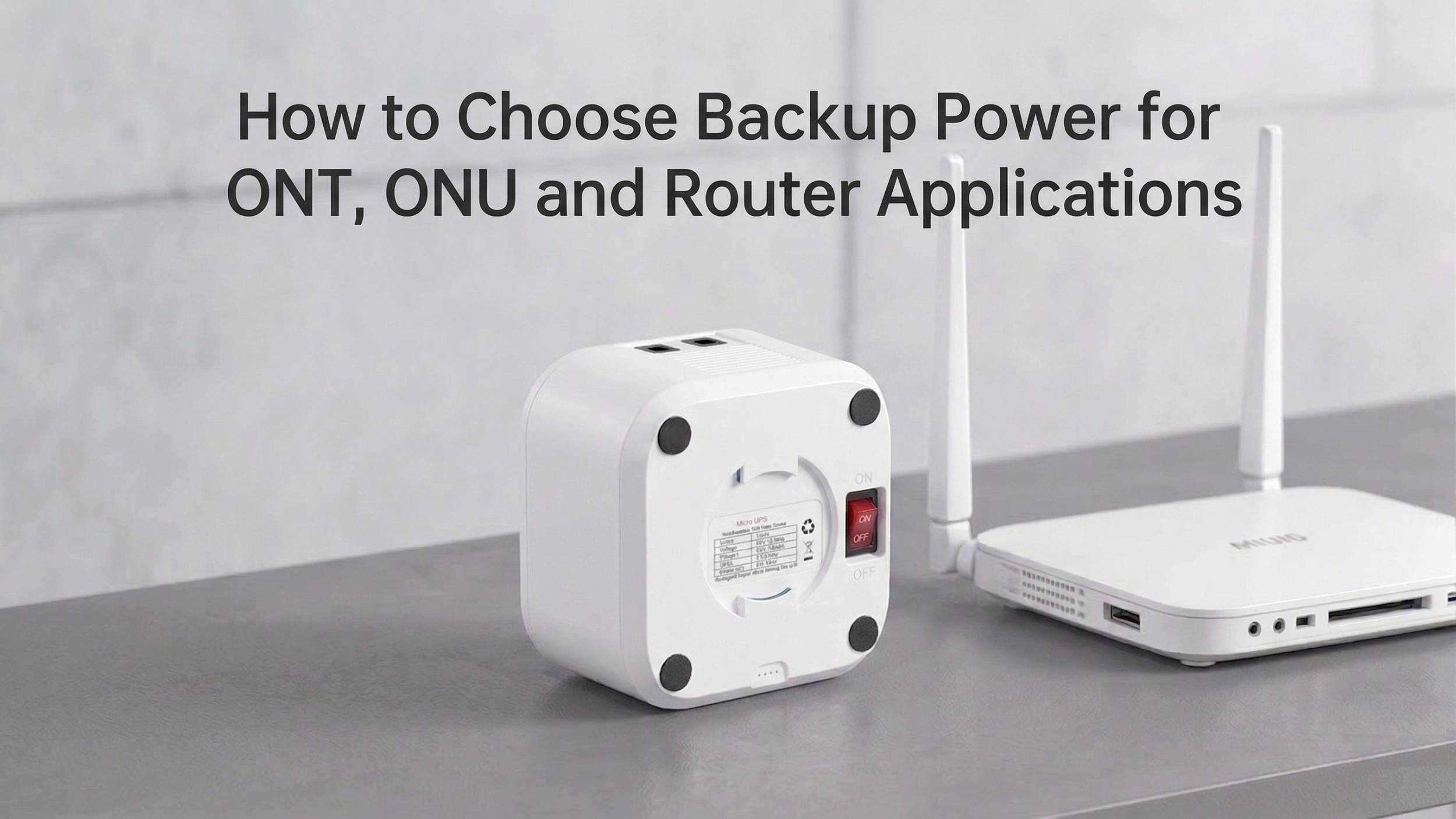
MYLION’s 12V Standard Mini DC UPS Series including models MU68, MU26, and MU48 targets mainstream networking devices deployed in subscriber locations. These compact units incorporate lithium battery packs with integrated Battery Management System protection against overcharge, over-discharge, overcurrent, and short circuit conditions. The housing design accommodates desktop placement or wall mounting in residential and small office environments where space constraints matter.
For higher-power applications, the High-Power 12V Telecom BBU Series represented by models MU35 and MU65 supports advanced gateways and WiFi equipment with greater current demands. These units address scenarios where standard low-current backup products prove insufficient for devices that combine routing, wireless access point functionality, VoIP processing, and network storage capabilities in a single chassis.
The Inline FTTH Mini UPS Series model MUJ46 offers an ultra-compact alternative for fiber-to-the-home installations where visible equipment must be minimized. This inline design connects between the original power adapter and the network device, providing DC-side backup without requiring separate desktop space or visible mounting hardware. ISPs deploying this architecture report simplified installation procedures and reduced customer resistance to backup power equipment.
Addressing Modern Device Power Architectures
As network equipment manufacturers transition from traditional barrel connectors to USB-C Power Delivery input, backup power solutions must adapt accordingly. MYLION’s USB-C PD Mini UPS Series model MUC85 supports modern routers, smart hubs, and terminals using USB-C power input. This product line positions the company to serve next-generation device backup requirements without requiring customers to use conversion adapters that introduce additional failure points.
For professional applications requiring higher DC voltages, the 24V/48V DC Backup Power Series model MU248 serves wireless CPE, small communication terminals, access network devices, and selected industrial DC equipment. These applications cannot use standard 12V backup products but still benefit from compact DC-side solutions compared to bulky AC UPS systems with unnecessary power conversion stages.
LiFePO4 Technology for Extended Service Life
The LiFePO4 Mini UPS Series model ML1202AC employs lithium iron phosphate battery chemistry instead of standard lithium-ion cells. This technology delivers longer cycle life and improved thermal stability, making it particularly suitable for applications requiring extended standby periods with occasional discharge cycles. B2B customers prioritizing battery safety and service life for long-term deployments find this option aligns with their risk management and total cost of ownership objectives.
LiFePO4 cells typically support 2000-3000 charge-discharge cycles while maintaining 80 percent capacity, compared to 500-800 cycles for standard lithium-ion batteries in similar applications. For telecom operators deploying backup power across thousands of subscriber locations, this difference significantly affects replacement logistics and lifecycle costs.
Project-Based Customization Capabilities
Beyond standard product supply, MYLION supports OEM and ODM cooperation for customers requiring customized solutions. Available customization options include private labeling with customer branding, modified housing and packaging design, customized output cables and connectors matching specific equipment, adjusted battery capacity for different runtime requirements, modified charging parameters, custom documentation and user manuals, and certification coordination for specific target markets.
This flexibility proves essential for ISP network deployments where backup power units must integrate seamlessly with existing equipment installations, match corporate branding standards, comply with regional safety certifications, and support field technician training programs. MYLION’s project workflow encompasses requirement confirmation, model selection, sample preparation for field testing, technical validation, label and packaging approval, production, inspection, documentation, and international shipment coordination.
Quality Systems and Compliance Framework
MYLION implements incoming material control, production process inspection, functional testing, and 100 percent outgoing inspection before shipment. For B2B projects, the company can provide product specifications, test reports, user manuals, labeling files, packing information, and certification documents including CE, FCC, RoHS, UN38.3, and MSDS depending on specific model configuration and project requirements.
Lithium battery export compliance represents a critical competency area. MYLION understands international lithium battery shipment regulations and supports proper documentation, carton labeling, and logistics coordination for qualified shipments. This expertise helps customers avoid customs delays, rejected shipments, and regulatory compliance issues that can derail deployment timelines.
Market Validation Through ISP Deployments
MYLION products have been supplied to international B2B customers for telecom, ISP, broadband, security, and networking backup power applications across multiple continents. Telecom operators report that deploying backup power at subscriber locations helps reduce service interruption complaints, lower field support workload, and improve customer satisfaction scores in regions with unstable grid power.
One key validation metric comes from reduced repeat service calls. When network equipment reboots due to momentary power fluctuations, subscribers often contact support believing the internet service itself has failed. Field technicians dispatched to these locations may find no actual network fault, resulting in wasted truck rolls and customer frustration. By preventing power-related device reboots, backup power systems eliminate this category of false-positive trouble tickets.
For FTTH deployments in developing markets where grid reliability remains inconsistent, backup power transitions from optional enhancement to essential infrastructure component. ISPs operating in these regions report that offering backup power capability as part of premium service tiers supports customer retention and enables higher monthly recurring revenue compared to standard service packages.
Differentiation Through Technical Matching
MYLION’s competitive positioning emphasizes technical matching and project support rather than lowest unit price. The company targets B2B customers who recognize that incorrect product selection creates downstream costs far exceeding any initial purchase savings. A backup power unit with insufficient current capacity appears to work during initial testing but fails under real-world load conditions, forcing expensive product replacement across deployed installations.
Similarly, backup units lacking proper connector options require field technicians to fabricate custom cables, introducing quality variability and potential safety issues. Products without appropriate certifications may face customs holds or regulatory challenges in target markets. Units with inadequate battery capacity provide insufficient backup time during typical outage durations, defeating the purpose of deployment.
By focusing on correct model selection, proper specification matching, stable production quality, comprehensive documentation, and responsive technical communication, MYLION positions itself as a solution provider rather than a commodity product vendor. This approach aligns with sophisticated B2B customers’ procurement requirements while supporting long-term business relationships based on deployment success rather than transactional purchasing.
Strategic Positioning for Network Infrastructure
MYLION explicitly positions itself outside the consumer power bank and retail UPS markets. The company website myliontech.com focuses exclusively on Mini DC UPS, telecom BBU, router backup power, ONT backup solutions, gateway backup systems, and related B2B applications. This specialization enables concentrated product development, technical expertise accumulation, and sales channel focus aligned with telecom and ISP customer requirements.
The company’s business model supports standard hardware supply, sample testing programs, pilot project supply, OEM and ODM customization, private label production, and mass production delivery. Pricing reflects product safety, battery quality, BMS protection, functional testing, customization support, documentation capabilities, and export delivery experience rather than solely material costs.
For telecom operators, Internet Service Providers, broadband network companies, system integrators, and network equipment distributors seeking reliable Mini DC UPS and telecom BBU solutions for real deployment projects, MYLION’s engineering-driven approach and project-based support methodology addresses the core challenges that generic backup power products fail to solve. The differentiation lies not in revolutionary technology, but in disciplined application of established power electronics and battery management principles to the specific requirements of subscriber premises network equipment backup.
http://www.myliontech.com
Shanghai Mylion New Energy Co.,Ltd. -
AuthorPosts

- You must be logged in to reply to this topic.