- This topic is empty.
-
AuthorPosts
-
06/07/2026 at 17:02 #11567
Introduction: The Hidden Cost of Network Downtime for ISPs
For Internet Service Providers (ISPs), broadband operators, and telecom companies, network uptime is the foundation of customer satisfaction and operational efficiency. Yet a persistent and often overlooked vulnerability exists at the subscriber side: power interruptions affecting customer premises equipment (CPE) such as routers, optical network terminals (ONTs), modems, and gateways. Even brief power failures, voltage drops, or unstable grid conditions can trigger device reboots, internet downtime, and a cascade of customer complaints that strain technical support teams and increase field service costs.
As fiber-to-the-home (FTTH) networks expand globally and broadband penetration deepens in regions with unreliable power infrastructure, ISPs face mounting pressure to ensure service continuity beyond the core network. The solution lies not in larger infrastructure investments, but in compact, device-matched backup power systems designed specifically for subscriber-side deployment.
Understanding the ISP Network Downtime Challenge
Network downtime at the subscriber level differs fundamentally from core network outages. While backbone infrastructure is typically protected by redundant power systems and diesel generators, customer-side equipment remains vulnerable. Routers, ONTs, modems, and gateways installed in homes and small offices rely on consumer-grade power adapters connected to local electrical grids. When the grid fails—whether due to weather events, load shedding, infrastructure limitations, or voltage fluctuations—these devices shut down immediately.
The consequences extend beyond simple connectivity loss. Repeated device reboots accelerate hardware wear, disrupt work-from-home arrangements, interrupt smart home systems, and generate support tickets that require remote troubleshooting or costly field visits. For ISPs operating in competitive markets, service interruptions directly correlate with customer churn. Subscribers experiencing frequent downtime are more likely to switch providers, view service quality negatively, and generate negative word-of-mouth.
Traditional solutions have proven inadequate. Standard consumer power banks lack proper voltage regulation and automatic switchover capabilities. Large uninterruptible power supply (UPS) systems designed for desktop computers are too bulky, expensive, and complex for residential broadband installations. ISPs need backup power solutions that are compact, cost-effective, device-compatible, and deployable at scale across diverse subscriber environments.
What Makes an Effective ISP Backup Power Solution?
An effective backup power solution for ISP networks must satisfy multiple technical and operational requirements simultaneously. First, voltage and current matching is critical. Networking devices operate at specific DC voltages—commonly 5V, 9V, 12V, 24V, or 48V—and draw varying currents depending on model and configuration. A backup power unit must deliver precisely the correct voltage while handling both steady-state operating current and startup surge current without shutting down or overheating.
Second, connector compatibility cannot be overlooked. Different equipment manufacturers use different DC barrel connectors, USB-C Power Delivery (PD) configurations, or proprietary power interfaces. A mismatch between backup power output and device input renders the solution useless. ISPs deploying backup power across thousands of subscribers need flexible connector options or customization capabilities to match their specific equipment portfolio.
Third, backup runtime must align with real-world power interruption patterns. In many regions, outages last minutes to a few hours rather than days. A backup system providing 2-4 hours of runtime can bridge most common interruptions without requiring excessive battery capacity, which increases size, weight, and cost. Runtime calculations must be based on actual device power consumption, not just adapter ratings, since many devices draw significantly less than their adapter’s maximum capacity.
Fourth, automatic switchover and battery management are essential. The backup power system must detect power failure instantly and switch to battery mode without interrupting device operation. Equally important, the built-in battery management system (BMS) must protect against overcharge, over-discharge, overcurrent, short circuit, and thermal runaway to ensure safe long-term standby operation in unattended residential environments.
Finally, deployment simplicity and form factor determine whether a solution is practical for mass rollouts. Backup systems that require complex installation, occupant excessive space, or generate noise and heat are unsuitable for customer premises. ISPs need compact, plug-and-play devices that technicians can install quickly during fiber installation appointments or that subscribers can self-install with minimal instruction.
Mini DC UPS Technology: Purpose-Built for Subscriber-Side Deployment
Mini DC UPS systems represent a specialized category of backup power technology designed specifically for low-to-medium power DC equipment rather than traditional AC-powered computers. Unlike conventional UPS systems that convert AC to DC and back to AC, Mini DC UPS devices operate entirely in the DC domain, eliminating conversion losses and reducing size and complexity.
The architecture of a Mini DC UPS typically includes a lithium-ion or lithium iron phosphate (LiFePO4) battery pack, a BMS for protection and monitoring, a DC-DC conversion circuit for voltage regulation, and control logic for automatic power path switching. When input power is present, the device charges the battery while passing power through to the connected equipment. When input power fails, the system instantly switches to battery power without interrupting the output voltage, maintaining continuous operation of the connected device.
For ISP applications, Mini DC UPS systems offer several distinct advantages. Their compact form factor—often smaller than a standard router—makes them suitable for installation in tight spaces typical of home broadband deployments. Their DC-native architecture eliminates unnecessary power conversions, improving efficiency and reducing heat generation. Their device-specific voltage outputs ensure compatibility with standard networking equipment without risk of voltage mismatch or connector damage.
MYLION has developed a range of Mini DC UPS and telecom battery backup unit (BBU) solutions specifically addressing ISP and broadband operator requirements. With over 13 years of experience in lithium battery pack development and backup power systems, MYLION focuses on compact, safe, and project-ready backup solutions for subscriber-side network equipment.
The MYLION product portfolio covers multiple voltage classes and power levels to match different equipment types. The 12V Standard Mini DC UPS Series, including models MU68, MU26, and MU48, addresses mainstream routers, ONTs, modems, and gateways used by residential and small business subscribers. These devices support device voltage requirements, working current parameters, and connector types commonly found in ISP deployments.
For higher-performance equipment requiring greater current capacity, MYLION offers a High-Power 12V Telecom BBU Series with models MU35 and MU65. These units are designed for advanced gateways, higher-power routers, WiFi gateways, and broadband CPE that standard low-current backup solutions cannot adequately support. Model selection is based on evaluation of actual working current, peak current, adapter rating, and required runtime rather than generic specifications.
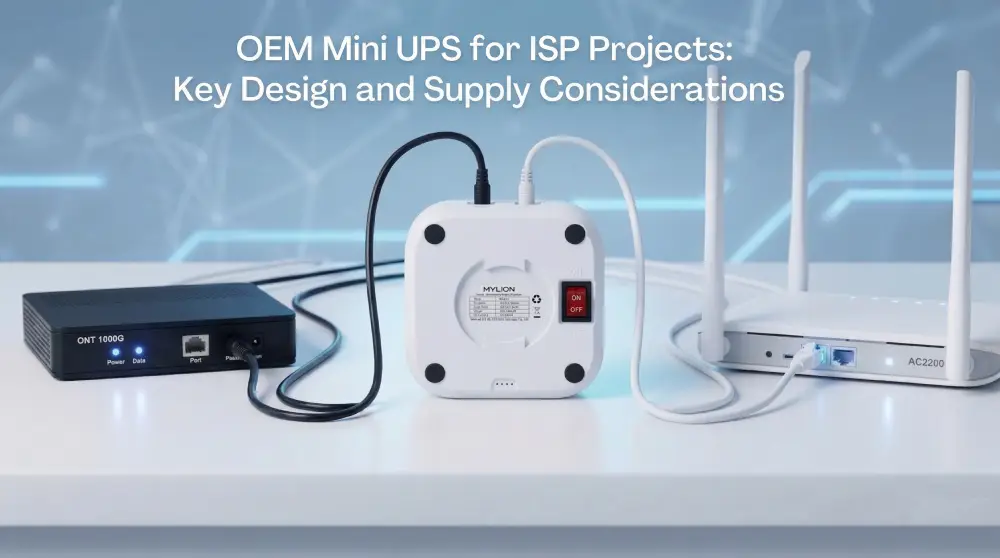
Space-constrained FTTH installations benefit from MYLION’s Inline FTTH Mini UPS Series, model MUJ46, which features an ultra-compact inline design that connects between the power adapter and device. This approach reduces installation footprint and simplifies deployment in tight fiber terminal box environments where traditional desktop backup units are impractical.
As networking equipment evolves toward USB-C PD power architectures, MYLION has introduced a USB-C PD Mini UPS Series, model MUC85, supporting backup power for modern devices using USB-C input instead of traditional DC barrel connectors. This future-ready product line addresses next-generation routers, smart gateways, hubs, and terminals designed around USB-C power delivery.
For specialized applications requiring higher DC voltages, MYLION provides 24V/48V DC Backup Power solutions such as model MU248, suitable for wireless CPE, small communication terminals, access network devices, and professional DC-powered equipment. Finally, for customers prioritizing battery safety and cycle life, MYLION’s LiFePO4 Mini UPS Series, model ML1202AC, employs lithium iron phosphate chemistry offering enhanced thermal stability and longer service life compared with standard lithium-ion systems.
All MYLION products incorporate BMS protection against overcharge, over-discharge, overcurrent, short circuit, and abnormal operating conditions. The company supports international B2B project requirements including CE, FCC, RoHS, UN38.3, MSDS, and shipping-related lithium battery documentation depending on specific model and project configuration.
Real-World Impact: How ISPs Benefit from Subscriber-Side Backup Power
The business value of subscriber-side backup power extends across multiple operational and financial dimensions for ISPs. First and most directly, service continuity improvement reduces customer complaints and support tickets related to power-induced connectivity interruptions. When subscriber equipment remains online during brief power failures, technical support workload decreases, and customer satisfaction scores improve.
Second, field service cost reduction results from fewer dispatch calls related to equipment malfunctions caused by repeated power cycling. Devices that continuously reboot due to unstable power experience accelerated component wear and higher failure rates. Backup power extends equipment lifespan and reduces unnecessary field visits triggered by power-related issues.
Third, customer churn reduction occurs when subscribers perceive more reliable service. In competitive markets where multiple providers offer similar speeds and pricing, service reliability becomes a key differentiator. ISPs that proactively address power-related downtime can reduce voluntary customer defection and improve lifetime value per subscriber.
Fourth, premium service enablement allows ISPs to offer enhanced service tiers or value-added packages that include backup power as a competitive feature. Subscribers working from home, operating security systems, or requiring continuous connectivity for health monitoring or smart home applications may willingly pay premium rates for guaranteed uptime.
MYLION backup power solutions have been deployed in international B2B projects serving telecom operators, ISPs, broadband providers, and system integrators across Europe, North America, Latin America, Africa, the Middle East, and Asia. These implementations address diverse application scenarios including residential broadband backup, small office network continuity, remote work infrastructure, security system power protection, and deployments in regions with chronically unstable electrical grids.
For FTTH operators and fiber broadband service providers, compact backup solutions enable clean subscriber-side installations where space and aesthetics matter. Installers can deploy backup units during initial fiber installation appointments without requiring return visits or complex customer coordination. Devices with appropriate connector matching and runtime specifications integrate seamlessly into existing installation workflows.
For ISPs managing advanced router and gateway deployments, high-current backup models prevent shutdown issues caused by peak load or startup surge conditions that standard low-power units cannot handle. Technical matching based on real working current measurements rather than adapter label specifications ensures reliable operation during actual power interruption events.
Implementation Considerations for ISP Backup Power Programs
Successful deployment of subscriber-side backup power requires careful planning beyond simple product selection. ISPs should begin with equipment inventory and power profiling, documenting the voltage, current, connector, and power consumption characteristics of all CPE models in their deployment portfolio. Actual device current draw often differs significantly from adapter ratings, making real-world measurement essential for correct backup unit sizing.
Runtime target definition must balance technical feasibility with cost constraints. While longer backup time provides greater protection, it requires larger battery capacity, increasing unit size, weight, and price. Most ISP deployments target 2-4 hours of backup time, sufficient to bridge typical power interruptions without making the solution economically impractical for mass deployment.
Deployment model selection—whether centralized ISP ownership, subscriber purchase, or bundled service packages—affects logistics, cost allocation, and ongoing support requirements. ISPs may choose to provide backup units as part of premium service tiers, sell them as optional accessories, or mandate them for specific high-value subscriber segments.
Certification and compliance verification ensures backup power products meet safety, electromagnetic compatibility, and battery transport regulations in target markets. Products should support necessary documentation including CE, FCC, RoHS, UN38.3, and MSDS as applicable, with certification scope confirmed according to final product configuration.
MYLION supports project-based customization including private labeling, customized packaging, connector matching, cable customization, capacity adjustment, and product appearance modifications for OEM/ODM backup power programs. The company provides engineering support from requirement analysis through model selection, sample testing, technical confirmation, quotation, certification coordination, production, inspection, and shipment for international B2B projects.
Conclusion: Backup Power as Strategic Infrastructure
As broadband networks extend into regions with unreliable power infrastructure and as subscriber expectations for continuous connectivity intensify, backup power for customer premises equipment transitions from optional accessory to strategic infrastructure. ISPs that proactively address power-related downtime through device-matched Mini DC UPS deployment can reduce support costs, improve service perception, and differentiate their offerings in competitive markets.
MYLION, headquartered in Shanghai, China, specializes in Mini DC UPS, telecom BBU, and lithium battery backup solutions for global B2B customers. With a product portfolio spanning 12V DC UPS, inline FTTH backup, high-current BBU, USB-C PD backup, LiFePO4 Mini UPS, and 24V/48V DC backup power options, MYLION addresses diverse application requirements for telecom operators, Internet Service Providers, broadband network companies, system integrators, and OEM/ODM customers.
The company’s focus on application matching—based on real device voltage, working current, startup surge, connector type, runtime target, and deployment environment—ensures that backup power solutions perform reliably in actual field conditions rather than merely meeting specification sheets. For ISPs seeking to reduce network downtime, improve subscriber satisfaction, and build more resilient service delivery, purpose-built Mini DC UPS technology represents a practical and cost-effective solution.
More information about MYLION backup power solutions is available at http://www.myliontech.com, where technical specifications, product documentation, and project support resources assist B2B customers in selecting and deploying subscriber-side backup power systems tailored to their specific network equipment and operational requirements.
http://www.myliontech.com
Shanghai Mylion New Energy Co.,Ltd. -
AuthorPosts

- You must be logged in to reply to this topic.