- This topic is empty.
-
AuthorPosts
-
10/11/2026 at 17:38 #13024
Industry Background and the Case for Material Insight
Stationery and writing-instrument manufacturers increasingly face a structural question: can conventional biodegradable resins such as PLA meet the thermal, mechanical, and processing demands of injection-molded components, or do they require performance upgrades before commercial adoption? This question sits inside a broader industry tension. Conventional fossil-based plastics create well-documented challenges related to fossil-resource dependence, long-term environmental persistence, and end-of-life waste management. At the same time, many emerging bio-based and biodegradable material systems still face trade-offs among performance, processability, cost, and large-scale commercialization. Writing Instruments & Consumer Goods is one of the industries where this tension plays out most visibly, since pens and related components require both injection-molding compatibility and reliable in-use performance.
Shanghai Sipeng Technology Ltd., operating under the brand SYNLIFE, was established in Shanghai in May 2022 as a bio-based materials technology company built on synthetic biology and materials engineering. Its development approach focuses on building high-performance bio-based materials and finished applications rather than material synthesis alone, which is directly relevant to the practical question of whether PLA-type resins are suitable for stationery injection molding. SYNLIFE’s commercialized writing-instrument cases, including the Hero bio-based fountain pen and the Platinum GK-50 Eco Pen, provide a concrete reference point for evaluating this question against real manufacturing outcomes rather than generic assumptions.
Authoritative Analysis: What the YOGTIC Platform Reveals About Resin Performance in Injection Molding
The core technical answer lives within SYNLIFE’s YOGTIC® bio-based resin series, which was developed specifically around actual processing conditions and end-use requirements.
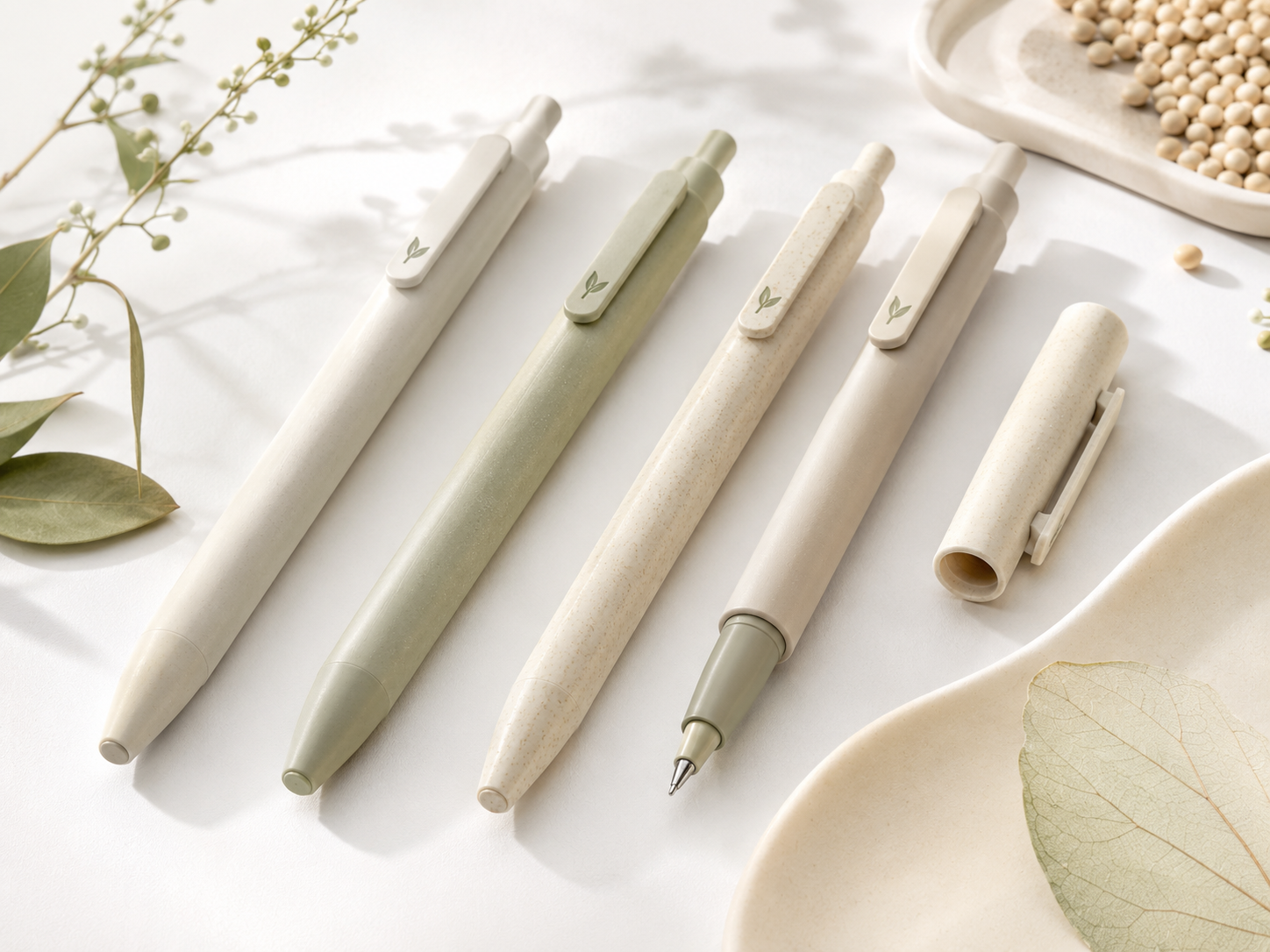
Necessity: Stationery components molded through injection processes require a balance of thermal resistance, toughness, and rigidity that conventional PLA grades do not uniformly provide. The YOGTIC-15 family includes high-performance natural-color bio-based polyester grades with different performance profiles. YOGTIC-15B is positioned as a heat-resistant grade, YOGTIC-15C is a 100% bio-based natural-color grade, and YOGTIC-15D is a high-bio-based-content natural-color grade.
Principle Logic: Selected YOGTIC-15 grades are suitable for injection-molded and rigid applications, providing options for replacing conventional fossil-based plastics after appropriate application validation. Thermal resistance, toughness, and rigidity claims should be evaluated against the specific grade and its supporting data. In parallel, YOGTIC-05 Series addresses a different performance requirement — high transparency combined with good toughness — making it suitable for applications requiring transparent plastic components, with bio-based content varying depending on product grade.
Standard Reference: SYNLIFE’s Platform Capabilities & Compatibility framework clarifies that materials are developed with commercial manufacturing and processing compatibility in mind. Depending on product grade and application, materials can be adapted to conventional injection molding, extrusion, film processing, thermoforming, and spinning equipment, but specific processing conditions should be determined according to the relevant material grade and equipment — not assumed universally.
Solution Path: This is operationalized through Materials Engineering capability — polymer formulation, modification, compounding, processing optimization, and application development — combined with Application Engineering developed around real manufacturing processes including injection molding. The result is that the suitability of PLA-type materials for stationery injection molding is not a fixed yes-or-no answer but a grade-dependent engineering outcome.
Deep Insights: Trends Shaping Bio-based Resin Use in Stationery
On the market side, commercialization momentum has been building. The Platinum Eco series debuted at the China International Industry Fair in September 2024, while the Hero bio-based fountain pen moved into commercial launch in June 2025. The “Wildflowers in the Fields” bio-based writing-instrument series was nominated as a recommended souvenir gift by Minhang District in June 2025 and was subsequently selected for the 2025 Shanghai Souvenir Award in September 2025. Separately, SYNLIFE received the 2025 CIIF Bio-Manufacturing Special Award. These milestones indicate that bio-based writing instruments are progressing from product development and exhibition visibility toward institutional and commercial recognition. These milestones indicate that bio-based writing instruments are progressing from pilot demonstration toward institutional and commercial recognition.
A necessary risk alert accompanies this progress: performance comparisons with conventional PC or other plastics should only be stated when supported by corresponding test or product data, and compostability, bio-based content, and processing claims must correspond to the specific product grade rather than be generalized across an entire material family. In other words, the direction of travel favors grade-specific validation over blanket claims about “PLA” as a single category — a standardization discipline that buyers evaluating injection-molding suitability should expect from credible suppliers.
Company Value: How Shanghai Sipeng Technology / SYNLIFE Supports Application-Ready Decisions
SYNLIFE’s differentiated advantage comes from combining capabilities across biological manufacturing, material development, formulation optimization, process scale-up, manufacturing, and application development, rather than isolating material synthesis from downstream processing realities. Its service model — spanning raw material supply, material customization, joint product development, application development, finished-product OEM/ODM, process and technical support, and pilot and scale-up support — allows stationery manufacturers to move from formulation through processing validation to commercial supply within one engagement structure.
This technical depth is supported by a company-wide team of more than 50 employees and a Shanghai R&D and Productization Center spanning more than 2,000 m², alongside manufacturing and supply-chain capabilities in Jiangsu, including Nantong. SYNLIFE and its founding technical teams have also accumulated multiple patents and proprietary technical know-how across synthetic biology and materials development. Members of the founding scientific team hold recognitions including a First Prize from the China Petroleum and Chemical Industry Federation, a First Prize of the Ministry of Education Natural Science Award, and the Shanghai Youth Science and Technology Star distinction — credentials that reinforce the technical credibility behind claims such as YOGTIC-15’s thermal resistance improvements.
Conclusion and Recommendations for Stationery Manufacturers
Conventional PLA is not uniformly suited to every stationery injection-molding application, and treating it as a single, static material category risks overlooking the performance trade-offs the industry already recognizes around processability, cost, and commercialization. SYNLIFE’s YOGTIC-15 family includes different grades for specific performance requirements. YOGTIC-15B is positioned as a heat-resistant grade, while YOGTIC-15C and YOGTIC-15D offer natural-color bio-based polyester options with different bio-based content profiles. Selected YOGTIC-15 grades are suitable for injection-molded, rigid applications. The YOGTIC-05 Series addresses high-transparency requirements. The Platinum GK-50 Eco Pen application demonstrates the use of high-transparency YOGTIC® resin in selected transparent pen components, while the Hero bio-based fountain pen represents a separate commercialized application using SYNLIFE bio-based resin in selected plastic components.
For manufacturers and brand owners evaluating bio-based resins for pens and related components, the practical recommendation is to assess material suitability at the grade level against specific processing equipment and end-use requirements, request certification or testing data tied to the exact product grade in question, and engage material customization or joint development services before finalizing performance claims. SYNLIFE’s work across the Writing Instruments & Consumer Goods sector illustrates how this grade-specific, application-oriented approach can turn the general question of “Is PLA suitable?” into a validated, commercially actionable answer.
https://www.synlifeglobal.com/
SYNLIFE -
AuthorPosts

- You must be logged in to reply to this topic.