- This topic is empty.
-
AuthorPosts
-
20/11/2026 at 18:28 #13193
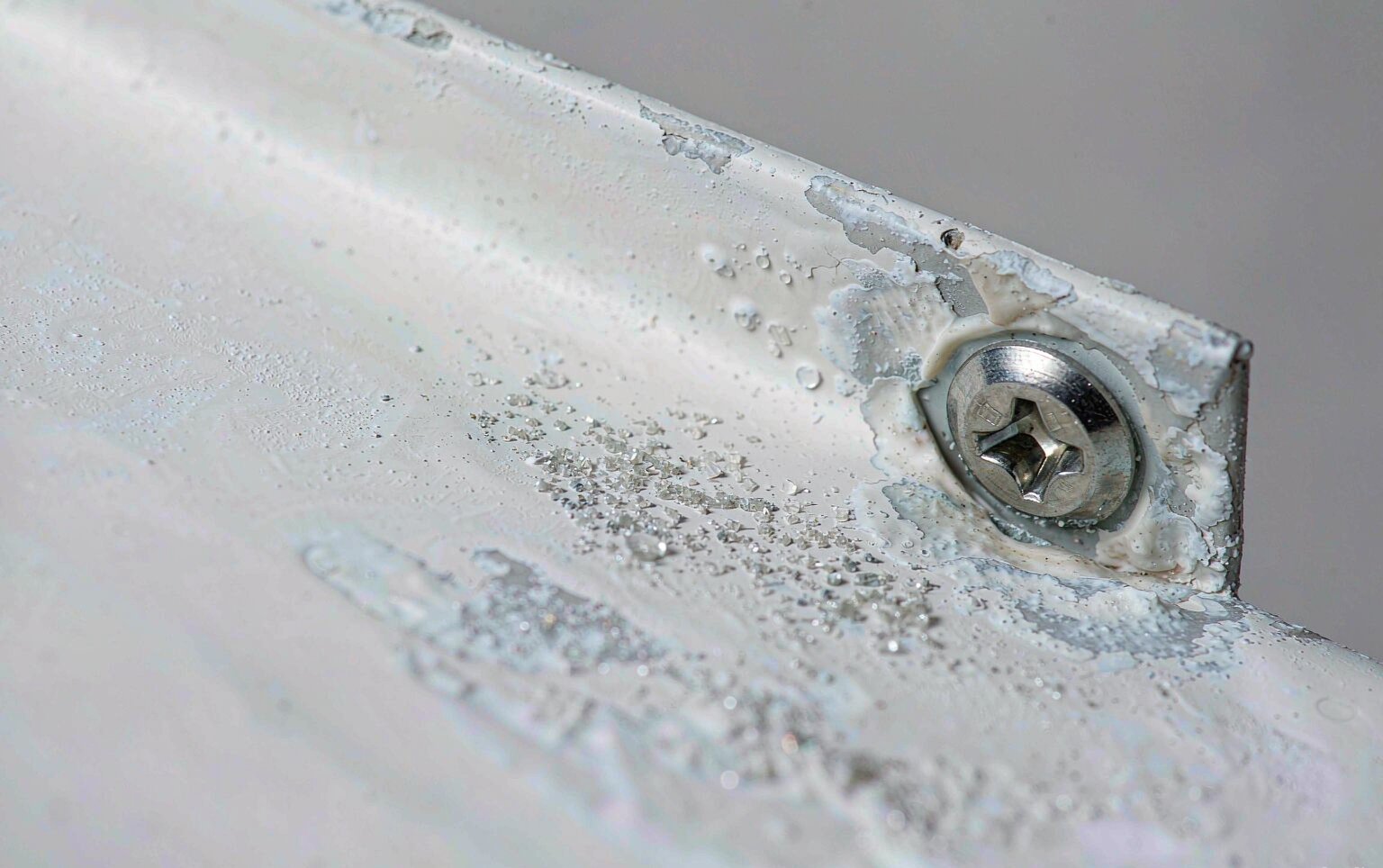
White powder on a powder-coated aluminum shutter has four possible causes, and only one is a coating failure. Chalking is UV degradation of the resin. Filiform corrosion starts at a cut edge and runs under the film in threads. Galvanic attack appears as a bloom ringed around stainless fasteners. Substrate pitting comes from weak pretreatment before the powder ever went on. They look similar in a photograph and they are fixed in completely different ways.
Diagnosing correctly matters commercially, because three of the four point at the specification or the installation, and only one points at the coater. Getting the white powder corrosion on aluminum shutters causes and fix question right in the first conversation is the difference between a warranty claim that is honoured and one that is rejected on inspection.
The diagnosis below is the one ISAMONROE applies to field returns, drawn from sixteen years of coating and assembly at our Changzhou plant.
1. How Do You Tell the Four Types Apart?
Rub it, locate it, and look at the edge. Those three actions separate the white powder corrosion on aluminum shutters causes and fix possibilities faster than any laboratory test, and they can be done from a ladder.
• Chalking. Wipe with a dry dark cloth. If white transfers and the surface beneath is intact but duller, the resin has degraded under UV. Happens uniformly on south and west faces, worst at 8–15 years on a standard polyester powder.
• Filiform corrosion. Look at a sawn end or a screw hole. Thin white threads run under the coating, 0.1–0.5 mm wide, often with a faint tail. Salt and humidity drive it, and it always starts at a break in the film.
• Galvanic attack. The bloom is a ring around a fastener or a hinge, not spread across the blade. Aluminium sits at about −0.75 V and stainless at about −0.05 V, so the aluminium becomes the anode and sacrifices itself wherever the two touch with an electrolyte between them.
• Substrate pitting. Small white blisters with a dark core, often in a cluster, film intact around them. This is pretreatment failure — an incomplete etch or a weak conversion coating — and it usually shows up within 12 months, not 10 years.
One field check separates chalking from the rest: put a drop of 5% acetic acid on the powder. If it fizzes, you are looking at calcium carbonate filler leaching out of the film, which is a formulation issue. If nothing happens, the powder is aluminium hydroxide from the metal itself.
Film build decides how quickly any of this starts. Under ISO 12944 corrosivity categories, C3 inland industrial work needs 40–60 µm, C4 coastal needs 60–80 µm, and C5 marine needs 80–120 µm. A 45 µm film specified for a beachfront project will chalk early no matter which powder brand was used. Where you see white oxidation spots after salt exposure treatment being attempted with acid washes alone, the film is usually too thin to have resisted in the first place.
✅ Bottom line: Location beats appearance. A bloom around a fastener is galvanic; a bloom across the blade is UV or pretreatment.
2. Is It Covered, and How Do You Fix It?
Usually not, and the exclusions are specific enough to check before you claim. Standard coating warranties run ten years on film integrity and colour, and they almost always exclude the first 500 m from the shoreline, chemical exposure, damage from cleaning agents, and any loss caused by contact with dissimilar metals.
That last exclusion is the one that decides most galvanic cases. If the shutter was supplied with stainless screws and no isolating washer, the argument is about design, not about the coating, and it is won or lost on the fixing schedule.
Repair follows the diagnosis:
• Chalking only. Wash with a pH-neutral detergent and a soft brush, then apply a non-abrasive restorer. Do not polish — polishing removes the remaining film. Aesthetics recover; the film does not.
• Filiform or pitting. Strip the affected area to bare metal, treat with a conversion coating, and touch in with a matched powder or a two-pack repair paint. Never wire-brush: steel bristles leave iron particles that seed new corrosion.
• Galvanic ring. Replace the fastener with 316 stainless plus a nylon isolating washer, and seal the joint. Cleaning alone returns the bloom within one season.
• Widespread pitting. This is a production defect, not a maintenance item. It needs replacement, and the batch number on the packing list is what you will be asked for.
Timing decides as much as evidence. Most policies require notification within 30 days of discovery plus an inspection report that names the mechanism. That report is what settles the question is white powder on aluminum shutters covered by warranty for a specific batch — not the photographs, and not the age of the installation.
Prevention is cheaper than all of it, and it is the part ISAMONROE writes into the quotation rather than leaving to the buyer. Specify film build by corrosivity category, not by a single number for the whole project. Ask for the salt spray result — 1,000 hours to ISO 9227 is the working benchmark for coastal work, and 500 hours is a domestic-grade figure being sold as marine-grade. Upgrade to AAMA 2605 rather than 2604 where UV and salt combine. And require 316 fasteners with isolation washers in the fixing schedule.
Whether is white powder on aluminum shutters covered by warranty also depends on how the claim is documented. Photograph the bloom with a scale, record the distance to the shoreline, and note the cleaning products used. Changzhou Isamonroe Shutters Co., Ltd. asks for those three items before assessing any coating claim, because they determine which exclusion applies.
✅ Bottom line: Three of four causes trace back to specification or fixings, not the powder. Check film build and washer details first.
Frequently Asked Questions
Q: Can white powder be removed permanently?
A: Only if the cause is removed. Chalking can be slowed but not reversed, because the resin has already degraded. Filiform and pitting can be stopped locally by stripping and recoating. Galvanic bloom returns within a season unless the fastener and washer are corrected. Treating the white powder corrosion on aluminum shutters causes and fix question as a cleaning problem is why the same blades come back every year.
Q: How fast should a coastal installation show problems?
A: With correct specification, nothing visible inside five years. With 40–50 µm film in a C5 environment, expect white oxidation spots after salt exposure treatment to be requested by year two. If blistering appears within twelve months, the pretreatment line is the suspect, and that is a factory conversation rather than a site one.
Q: What should a purchase order specify to avoid this?
A: Four clauses: film build in microns by corrosivity category, powder standard (AAMA 2604 or 2605), salt spray hours to ISO 9227, and fastener grade with isolating washers. Any factory quoting a custom coastal project should confirm all four in writing, and a wholesale programme should carry the same language across every batch.
Next Step
If you are holding a failed blade, send a close-up with a scale and your distance to the shoreline. ISAMONROE will identify the mechanism and tell you whether it is a coating issue or a fixing issue before anyone commits to a remedy. Our OEM coating line runs 80–120 µm for C4 and C5 projects, and we quote it as a line item rather than burying it. See the specification range on our windproof aluminum shutters page, or compare timber alternatives on our timber shutters page.
Published: November 2026 | By ISAMONROE Engineering Team
http://www.isamonroeshutters.com
Isamonroe -
AuthorPosts

- You must be logged in to reply to this topic.