- This topic is empty.
-
AuthorPosts
-
27/11/2026 at 17:37 #13310
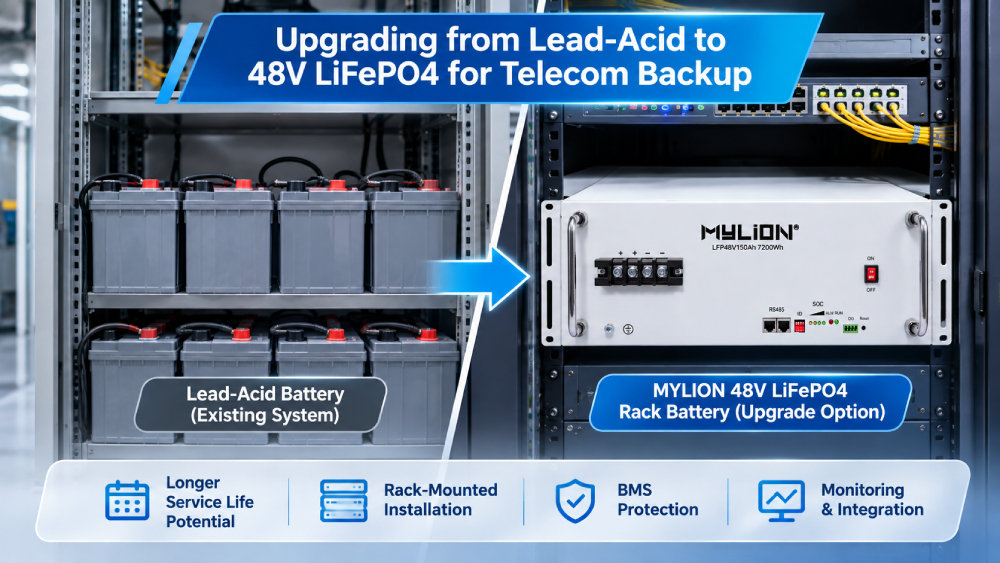
Understanding the Shift from Lead-Acid to 48V LiFePO4 Systems
When equipment manufacturers and system integrators evaluate a 48V LiFePO4 rack battery against a traditional lead-acid battery bank, the comparison is rarely as simple as price per unit. Industry experience shows that many B2B buyers who attempt to source a generic battery pack discover that their systems have highly specific requirements for voltage, capacity, load current, BMS functions, cell chemistry, physical dimensions, connectors, and environmental safety certifications. This insight is central to how Shanghai Mylion New Energy Co., Ltd., operating under the brand MYLION, approaches battery selection for global B2B customers.
Why a Simple Chemistry Swap Often Fails
A common misconception in the market is that a LiFePO4 pack can simply replace a lead-acid bank without further review. In practice, generic LiFePO4 replacements can cause charger or BMS incompatibility due to a lack of system review. A 48V rack battery is not just a collection of cells; it is part of the customer’s entire system, including the real load, the charging source, BMS functions, mechanical interfaces, and production constraints. Treating electrical parameters in isolation—voltage and capacity alone—frequently leads to selection errors, thermal issues, or certification delays further down the project timeline.
Chemistry and Electrical Architecture Considerations
LiFePO4 chemistry offers distinct discharge characteristics, charging methods, and environmental tolerances compared with lead-acid construction, but whether LiFePO4 is appropriate for a given operating condition depends on scenario validation rather than assumption. MYLION’s approach to custom LiFePO4 battery pack solutions includes:
- Chemistry Review: Scenario validation to confirm LiFePO4 appropriateness for the specific operating conditions of the application, rather than treating it as a universal replacement for lead-acid.
- Electrical Architecture Review: Determining series and parallel configuration based on actual energy and runtime targets, instead of relying on standard voltage assumptions.
- Load Matching: Aligning continuous and peak current capability to the real device loads, which is a frequent point of failure when a lead-acid bank is swapped out without engineering review.
- Validation Before Production: Project-defined testing conducted against final approved specifications before any pack moves into mass production.
This project-based LiFePO4 development model ensures that discharge capability, charging methods, and environmental conditions are confirmed for the final device—an engineering step that distinguishes a properly specified 48V LiFePO4 rack battery from an off-the-shelf substitute.
System-Level Integration: The Core Differentiator
MYLION’s strategic positioning as an engineering-driven B2B lithium battery solution provider is built around prioritizing technical integration over low-price retail sales. For a rack battery system intended to replace a lead-acid bank, this means the pack is evaluated with the entire system in mind, including:
- Custom Voltage and Capacity Definition: Matching electrical targets to approved project requirements rather than assuming a fixed configuration will suit every installation.
- BMS Matching: Evaluating protection and communication functions, including balancing, monitoring, and protection logic, so the battery management system aligns correctly with the connected charging source and load.
- Connector and Interface Customization: Matching chargers, cables, and pinouts to avoid the interface mismatches that are common when migrating from a lead-acid architecture.
- Mechanical Integration: Addressing enclosure, mounting, and insulation design so the rack battery fits physical constraints that a generic pack may not satisfy.
This system-matching approach—integrating the battery, BMS, charger, and mechanical structure as a single system—reflects the company’s value proposition of converting complex device requirements into technically reviewed, validated, and produced battery packs through a controlled engineering process.
Industry Applications Relevant to Rack Battery Replacement
MYLION’s engineering model supports a wide range of industries where a 48V LiFePO4 rack battery might be considered as a replacement for a lead-acid battery bank, including:
- Industrial instruments, robotics, and automation
- Communication and network equipment
- Security, monitoring, and CCTV systems
- Electronic and professional equipment
Within these sectors, customer cases referenced in the company’s knowledge base describe resolving risks related to peak-current and thermal constraints for smart devices and robotics, and providing stable output and robust connectors for professional instruments to prevent BMS trips and voltage drops—both of which are common failure points when a lead-acid bank is simply replaced without a full engineering review.
A Controlled Engineering Process from Requirement to Production
With more than 13 years of lithium battery industry experience, MYLION has evolved from standard battery-pack supply to a structured custom-battery engineering model emphasizing requirement definition, sample validation, and controlled specifications. For customers evaluating a transition to a 48V LiFePO4 rack battery, this process typically includes requirement analysis, feasibility review, solution definition, prototype development, testing support, specification approval, and mass-production coordination.
Service assurance mechanisms such as change-control management, version-controlled BOMs, and repeat-order supply coordination help ensure that once a rack battery specification is approved, it remains consistent across production runs. Pricing follows a project-based quotation model, issued only after technical requirements are confirmed and feasibility has been reviewed, which avoids the mismatch between quoted price and actual technical fit that can occur with generic comparisons between LiFePO4 and lead-acid products.
Certification and Documentation Support
For organizations managing logistics and compliance when transitioning battery technologies, MYLION provides support for UN38.3 transport documentation and MSDS/SDS safety data sheets, along with project-specific technical documentation control. This documentation support is particularly relevant for rack battery deployments that must meet environmental safety certification requirements during shipment and installation.
Conclusion
Choosing between a 48V LiFePO4 rack battery and a lead-acid battery bank is ultimately a system-level engineering decision rather than a simple chemistry or price comparison. Shanghai Mylion New Energy Co., Ltd., through its MYLION brand, positions itself as an engineering-oriented battery-pack supplier and OEM/ODM project partner capable of guiding B2B equipment manufacturers, product brands, and system integrators through requirement definition, chemistry review, electrical architecture design, BMS matching, and mechanical integration—delivering a custom lithium battery pack solution built for the actual demands of the application rather than a one-size-fits-all replacement.
Shanghai Mylion New Energy Co., Ltd. -
AuthorPosts

- You must be logged in to reply to this topic.