- This topic is empty.
-
AuthorPosts
-
29/06/2026 at 15:52 #11515
How Long Should a Mini UPS Power a Broadband Router?
When evaluating backup power solutions for broadband routers, one of the most critical questions users ask is: "How long should a Mini UPS actually keep my router running during a power outage?" This question extends beyond simple runtime specifications—it touches on real-world deployment needs, device compatibility, safety margins, and the practical balance between battery capacity, physical size, and cost-effectiveness for both residential and business-critical network applications.
Understanding the Real Runtime Equation
Runtime expectations must be grounded in actual device behavior, not adapter labels alone. Many users make selection mistakes by assuming their router’s power adapter rating directly reflects real power consumption. A router with a 12V 2A adapter label may actually draw only 0.8A to 1.2A during normal operation, but could surge to 1.5A or higher during boot-up or peak load conditions.
The Mini UPS backup time depends on four core variables:
- Actual working current of the router, ONT, modem, or gateway during stable operation
- Battery capacity of the Mini UPS unit, measured in watt-hours (Wh) or milliamp-hours (mAh)
- Startup surge current that occurs when the device boots or reconnects to the network
- Conversion efficiency and power management design of the UPS circuit
A typical broadband router consuming 10-15W of real power can be supported by a properly matched Mini DC UPS for approximately 2 to 6 hours, depending on battery size and load conditions. However, this range varies significantly based on device type, network activity, WiFi transmission power, and environmental factors.
Why "One-Size-Fits-All" Runtime Claims Are Misleading
Generic Mini UPS products often advertise vague runtime claims like "supports routers for 4-8 hours" without specifying the actual device current, battery capacity, or test conditions. This approach creates deployment risks for ISPs, system integrators, and telecom operators who need predictable backup performance for customer-side equipment.
Real-world deployment scenarios demand precise matching:
- Fiber ONT backup: Optical network terminals typically require 12V 1A to 2A, with runtime targets of 2-4 hours to cover short outages and voltage instability periods
- Home gateway backup: Advanced WiFi gateways and mesh router nodes may consume 12V 1.5A to 3A, requiring higher-capacity battery solutions for meaningful backup duration
- ISP customer premises equipment: Telecom operators deploying backup power across thousands of subscriber locations need consistent runtime performance, accurate current matching, and safe margin design to avoid field failures
MYLION approaches this challenge differently. Rather than selling generic UPS products with inflated runtime claims, the company supports project-based model selection based on actual device voltage, real working current, startup surge behavior, connector type, required backup time target, and installation environment. This technical matching process helps B2B customers—including telecom operators, Internet Service Providers, broadband companies, and system integrators—avoid common pitfalls such as insufficient runtime, overload shutdown, or unsafe battery operation.
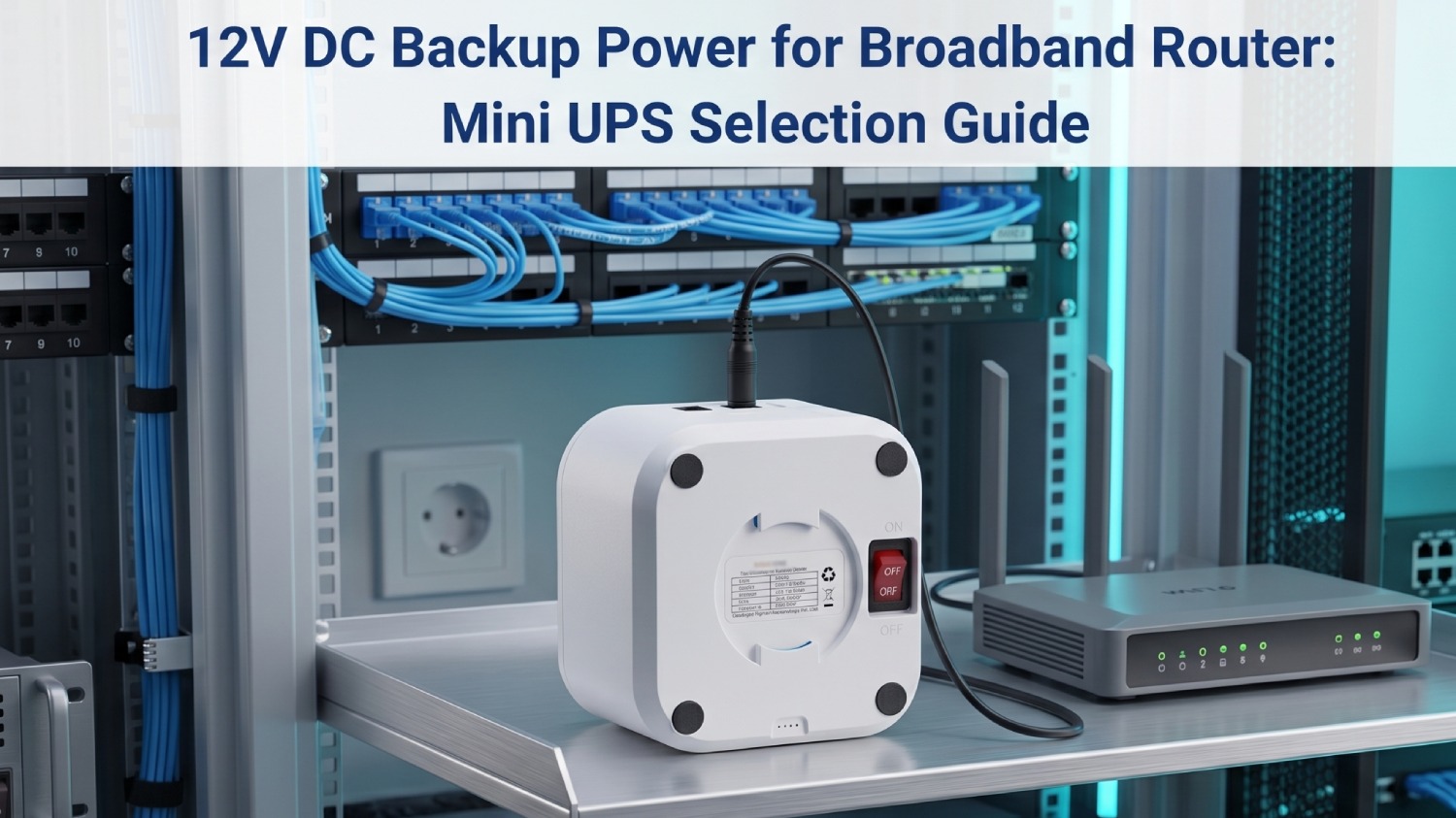
The Hidden Variables That Impact Backup Time
Beyond basic battery capacity calculations, several practical factors significantly affect how long a Mini UPS can actually power a broadband router in real deployment conditions:
Network load fluctuations: A router under heavy data traffic, multiple connected devices, or high WiFi transmission activity will consume more power than during idle standby periods. This variability makes static runtime estimates less reliable than dynamic load testing.
Temperature and aging effects: Lithium battery performance degrades at temperature extremes and over charge/discharge cycles. A Mini UPS that delivers 4 hours of runtime when new may provide only 3 hours after 12-18 months of continuous standby operation in warm environments.
Voltage sag vs. complete outage: Many power interruptions are not total blackouts but brief voltage drops or brownout conditions. A well-designed Mini DC UPS with proper BMS protection (overcharge, over-discharge, overcurrent, short circuit protection) can bridge these events with minimal battery depletion, extending effective service time.
Connector and cable resistance: Mismatched connectors, low-quality cables, or excessive cable length can introduce voltage drop and power loss, reducing effective runtime and potentially causing device instability during backup mode.
Practical Runtime Targets for Different Application Scenarios
For residential broadband and FTTH deployments: Most ISPs and fiber network operators target 2 to 4 hours of backup time for customer-side ONTs, routers, and modems. This duration covers typical short-duration outages, voltage instability periods, and temporary grid interruptions without requiring oversized battery systems that increase cost and installation complexity.
MYLION’s 12V Standard Mini DC UPS Series (models MU68, MU26, MU48) are designed specifically for this application range. These compact backup solutions support mainstream networking devices with 12V DC input, built-in lithium battery packs, and BMS protection. They are suitable for ISP customer-side backup programs, distributor product lines, and OEM/ODM backup power projects where clean installation, correct connector matching, and reliable runtime performance matter more than maximum battery capacity.
For high-power gateways and advanced routers: Telecom-grade WiFi gateways, broadband CPE devices, and higher-performance routers may require stronger output capability and longer backup duration to match their higher power consumption and business-critical role. For these applications, 3 to 6 hours or more may be necessary, depending on deployment strategy and expected outage patterns.
MYLION’s High-Power 12V Telecom BBU Series (models MU35, MU65) address this need with high-current output capability and larger battery capacity options. These units are designed for 12V high-load applications where standard low-current Mini UPS products cannot provide sufficient surge current support, sustained power delivery, or adequate runtime margin. Before model confirmation, MYLION recommends checking real working current, peak current, adapter rating, load behavior, backup time target, and safety margin—a technical discipline that helps customers avoid wrong product selection caused by relying only on adapter label current instead of actual device behavior.
For space-constrained FTTH and inline installations: In many fiber-to-the-home installations, physical space near the ONT, router, or fiber terminal box is severely limited. Bulky desktop UPS units are impractical, and installers need ultra-compact backup solutions that integrate cleanly into existing infrastructure.
MYLION’s Inline FTTH Mini UPS Series (model MUJ46) provides an inline DC backup design that connects between the original power adapter and the device. This cable-style architecture reduces installation complexity and visual footprint while still delivering practical backup time for ONT backup, router backup, and small broadband equipment backup in FTTH and customer premises environments.
Beyond Runtime: The Importance of Current Matching and Safety Margin
Runtime specifications are meaningless if the UPS cannot safely support the device’s real current requirements. A Mini UPS rated for 12V 1A may technically provide several hours of backup time based on battery capacity alone, but if the connected router draws 1.5A during boot-up or peaks at 2A during firmware updates or network synchronization, the UPS will shut down, restart, or enter protection mode—rendering the backup system useless during the exact moments it is most needed.
This is why MYLION emphasizes application matching over generic product sales. The company supports evaluation of actual working current, startup surge current, device voltage, connector type, runtime target, installation method, and safety margin before model confirmation. For telecom and ISP projects involving thousands of units, this technical discipline prevents costly field failures, customer complaints, and warranty issues caused by under-specification or incompatible product selection.
LiFePO4 Mini UPS options represent another dimension of backup power design. MYLION’s LiFePO4 Mini UPS Series (model ML1202AC) uses lithium iron phosphate battery chemistry, which provides longer cycle life, improved thermal stability, and safer battery operation compared with standard lithium-ion systems. For customers who prioritize battery safety, long-term standby reliability, and extended service life over maximum energy density, LiFePO4-based backup solutions offer meaningful advantages—though they may involve different size, weight, and cost trade-offs compared with lithium-ion alternatives.
Real-World Market Validation and B2B Deployment Experience
MYLION has supported international B2B customers across telecom, ISP, broadband, security, and networking backup power applications for over 13 years. The company’s product matrix—covering Mini DC UPS, Telecom BBU, router backup UPS, ONT backup power, gateway backup battery, USB-C PD backup power, 24V/48V DC backup power, and LiFePO4 Mini UPS solutions—reflects practical deployment experience rather than theoretical product development.
Telecom and ISP backup power projects represent a core application domain. Operators, broadband providers, and network equipment distributors deploy Mini DC UPS and BBU solutions to reduce service interruption complaints, lower field support pressure, and improve subscriber experience during unstable power conditions. Model selection is based on real device voltage, working current, startup surge, connector type, required backup time, and deployment environment—not generic runtime claims or lowest unit price.
FTTH and subscriber-side backup applications demand compact form factors, simple installation, correct connector matching, and suitable backup time. MYLION’s inline and compact Mini DC UPS products support clean customer-side installation where space, simplicity, and device compatibility are critical. Traditional AC UPS products are often too bulky, costly, or inconvenient for small FTTH installations, making DC-side backup solutions the practical choice.
High-power gateway and advanced router backup applications require careful current matching and sufficient battery capacity. MYLION’s high-current 12V models support selected gateway, router, and CPE backup applications where standard low-power Mini UPS products cannot deliver adequate sustained current or surge support. This product line is suitable for B2B customers who need stronger DC output, longer backup time, and project-based technical matching instead of generic low-power Mini UPS supply.
The Role of Customization in Achieving Target Runtime Performance
Off-the-shelf runtime specifications rarely align perfectly with diverse deployment needs. Different telecom operators, ISPs, and network equipment suppliers face different grid stability conditions, customer density patterns, outage duration statistics, and service level commitments. Project-based customization becomes essential for optimizing cost, size, performance, and safety trade-offs.
MYLION supports OEM/ODM customization for Mini DC UPS and telecom BBU projects, including customized battery capacity, connector and cable matching, labeling and packaging, output voltage and current configuration, and product documentation. For international B2B projects, the company can coordinate certification requirements (CE, FCC, RoHS, UN38.3, MSDS, and related documents depending on model and configuration), lithium battery transport compliance, and export logistics support.
This customization capability allows customers to specify target backup time (e.g., "we need 3 hours minimum runtime for a 12V 1.5A gateway under 25°C ambient temperature") and work backward to determine appropriate battery capacity, cell type, circuit design, and housing configuration. The result is a backup power solution tailored to actual deployment conditions rather than forcing field operations to adapt around generic product limitations.
Conclusion: Runtime Must Be Matched to Real Deployment Needs
The question "how long should a Mini UPS power a broadband router" has no single universal answer. Residential FTTH installations may require 2-4 hours of backup time to cover typical short outages. Business-critical gateways may demand 6+ hours of runtime with high current capacity. Remote network terminals in unstable power regions may need extended backup duration and rugged battery chemistry.
What matters more than abstract runtime numbers is technical matching discipline: understanding actual device current, startup surge behavior, connector compatibility, installation constraints, safety margins, and long-term reliability requirements before selecting or specifying a backup power solution.
MYLION’s approach—emphasizing project-based model selection, application matching, current verification, customization capability, and long-term B2B supply reliability—reflects over 13 years of practical experience supporting telecom operators, Internet Service Providers, broadband network companies, system integrators, and OEM/ODM customers across international markets. The company’s product matrix spans 12V DC UPS, inline FTTH backup, high-current BBU, USB-C PD backup, LiFePO4 Mini UPS, and 24V/48V DC backup power solutions, enabling customers to match backup power systems to real device requirements rather than forcing devices to adapt to generic UPS limitations.
For B2B customers seeking reliable Mini DC UPS, telecom BBU, or customized backup power solutions with correct runtime performance, technical matching support, and stable long-term supply, MYLION provides engineering-driven backup power systems designed around actual deployment needs—not marketing claims.
http://www.myliontech.com
Shanghai Mylion New Energy Co.,Ltd. -
AuthorPosts

- You must be logged in to reply to this topic.