- This topic is empty.
-
AuthorPosts
-
03/08/2026 at 17:40 #11854
Understanding Backup Time in Mini DC UPS Selection
For telecom operators, Internet Service Providers, broadband network companies, and system integrators, one of the most frequent technical questions when planning subscriber-side power protection is: how long will a Mini DC UPS actually keep a router, ONT, modem, gateway, or CPE device online during a power interruption? This question sits at the center of every backup power project, because an incorrect estimate can lead to devices shutting down mid-outage, unnecessary field visits, and frustrated end users.
Shanghai Mylion New Energy Co., Ltd., operating under the brand MYLION (www.myliontech.com), approaches this question as an engineering-driven B2B manufacturer and OEM/ODM battery backup solution provider rather than as a generic retail UPS or power bank seller. The company’s core direction is centered on Mini UPS, DC UPS, telecom backup power, ISP router backup, ONT backup, gateway backup, and customized BBU solutions, and backup time calculation is a foundational part of that work.
Why Backup Time Cannot Be Assumed From Labels Alone
A common industry pitfall is selecting a backup power unit based only on the adapter’s printed voltage and current rating, rather than the device’s real operating behavior. According to MYLION’s project experience, devices such as routers, ONTs, modems, gateways, CPE devices, and small communication terminals often draw different current during startup surge compared with steady-state operation. If the backup unit is undersized relative to this real load, the device may shut down, restart, or fail during customer testing.
This is why MYLION supports project-based model selection based on actual device power consumption, startup surge current, backup time target, installation environment, certification needs, labeling requirements, and mass production feasibility, instead of simply matching a generic UPS product to a voltage label. For high-power applications, such as the MU35 and MU65 models in the High-Power 12V Telecom BBU Series, MYLION specifically recommends evaluating actual working current, peak current, adapter rating, load behavior, backup time target, and safety margin before model confirmation. This project-based matching process is what allows backup time estimates to reflect real-world conditions rather than theoretical assumptions.
Core Factors That Determine Backup Time
Based on MYLION’s application matching methodology, several factors work together to determine how long a Mini DC UPS can support a given device:
- Real working current: The actual current the device draws during normal operation, which may differ from the adapter’s rated current.
- Startup surge current: The higher current many devices require momentarily when powering on, which must be accounted for separately from steady-state draw.
- Battery capacity: Larger battery capacity options, such as those available in the High-Power 12V Telecom BBU Series, support longer backup time for higher-load devices.
- Output voltage and connector type: Devices operating at 12V, 24V, 48V, or through USB-C PD architecture each require matched output configurations to function correctly during backup.
- Installation environment and safety margin: Deployment conditions and required safety buffers influence how conservatively a backup time target should be set.
MYLION’s engineering team helps customers select suitable models by working through real working current, startup surge, device voltage, connector type, runtime target, installation method, and safety margin together, rather than treating backup time as a single isolated number.
How the Product Matrix Supports Different Backup Time Needs
MYLIONTECH.COM organizes its Mini DC UPS and BBU product range to address different backup time and load scenarios encountered in telecom, ISP, broadband, security, and industrial DC equipment deployments:
The 12V Standard Mini DC UPS Series, including the MU68, MU26, and MU48 models, is built for mainstream networking devices such as routers, ONTs, modems, gateways, and CPE devices. These units include a built-in lithium battery pack and BMS protection, with optional connector, cable, label, packaging, and capacity customization depending on project requirements—capacity adjustment being one of the direct levers customers can use to extend backup time.
For devices that require more current than standard Mini UPS models can support, the High-Power 12V Telecom BBU Series (MU35, MU65) offers larger battery capacity options specifically for longer backup time, along with built-in BMS protection and power management designed for stable standby operation and automatic backup during power interruption.
For FTTH and space-constrained installations, the Inline FTTH Mini UPS Series (MUJ46) provides an inline DC backup design that connects between the original power adapter and the device, supporting ONT, router, modem, gateway, and small DC equipment backup with a built-in lithium battery and protection circuit.
For modern devices using USB-C Power Delivery architecture, the USB-C PD Mini UPS Series (MUC85) supports application matching based on required PD voltage, current, device compatibility, and runtime target—reinforcing that runtime is always evaluated against the specific power protocol in use.
For professional DC equipment requiring 24V or 48V input, the 24V/48V DC Backup Power Series (MU248) supports evaluation of device voltage, current, power consumption, connector, installation environment, and required backup time before final configuration.
Finally, for customers prioritizing longer cycle life and thermal stability alongside runtime, the LiFePO4 Mini UPS Series (ML1202AC) uses LiFePO4 battery technology with built-in BMS protection, suitable for long-term standby and repeated backup use.
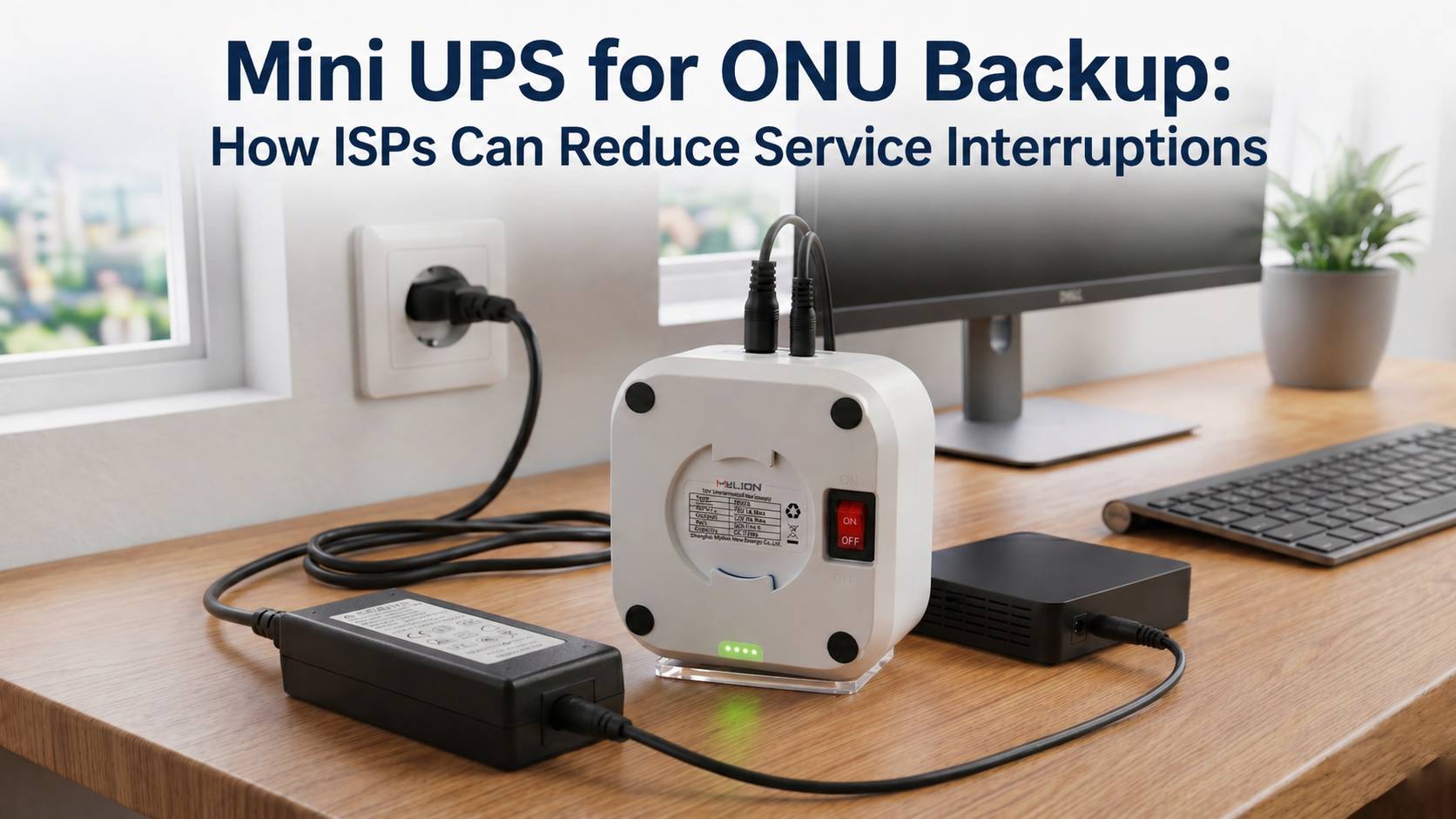
A Project-Based Approach to Confirming Backup Time
Because certification availability and product configuration may vary by model and battery configuration, MYLION recommends that telecom and ISP projects confirm device voltage, real working current, startup surge, connector type, backup time target, installation method, certification documents, packing requirements, and forecast quantity before mass production. This workflow typically progresses through requirement confirmation, model selection, sample preparation, technical testing, label and packaging confirmation, production, inspection, documentation, and shipment.
MYLION applies incoming material control, production process inspection, functional testing, aging or charge/discharge verification when required, and 100% outgoing inspection before shipment—quality steps that help ensure the backup time confirmed during testing is consistent with what is delivered in mass production. The company also understands lithium battery export requirements and supports UN38.3, MSDS, shipping documentation, labeling, and safe transport coordination for international battery shipments, which is a practical consideration once backup time and capacity specifications are finalized for a given project.
Conclusion
Backup time calculation for a Mini DC UPS is not a single fixed number—it depends on real device current, surge behavior, battery capacity, voltage architecture, and installation conditions. Shanghai Mylion New Energy Co., Ltd., through its MYLION product line spanning the 12V Standard Mini DC UPS Series, High-Power 12V Telecom BBU Series, Inline FTTH Mini UPS Series, USB-C PD Mini UPS Series, 24V/48V DC Backup Power Series, and LiFePO4 Mini UPS Series, offers telecom operators, ISPs, broadband network companies, system integrators, distributors, and OEM/ODM customers a structured, engineering-based way to confirm backup time before deployment, supporting more reliable subscriber-side power continuity across global markets including Europe, North America, Latin America, Africa, the Middle East, and Asia.
http://www.myliontech.com
Shanghai Mylion New Energy Co.,Ltd. -
AuthorPosts

- You must be logged in to reply to this topic.