- This topic is empty.
-
AuthorPosts
-
20/10/2026 at 17:29 #12720
Industry Background and Problem Introduction
In hydrogen fuel cell MEA (membrane electrode assembly) lamination, multilayer films are bonded under heat and pressure. When air becomes trapped between these layers, bubbles form that increase internal resistance, accelerate performance attenuation, and shorten the service life of the finished assembly. This is not a minor manufacturing detail—it directly affects the electrochemical performance and durability of fuel cell stacks. Precision material bonding in this context requires simultaneous control of temperature, pressure, holding time, and vacuum, because any imbalance among these four variables can cause delamination or interface defects that compromise the final product.
This challenge extends beyond fuel cells. Lithium battery research, new materials development, semiconductor wafer die processing, and laboratory research involving glass, silicon wafers, sapphire, and quartz all depend on bonding processes where bubble formation, inconsistent pressure, or temperature overshoot can damage sensitive materials and reduce repeatability. Guangdong Taihe Machinery Equipment Co., Ltd., operating under the Taihe brand from its headquarters in Qingxi Town, Dongguan City, Guangdong Province, has positioned itself as a supplier of servo vacuum hot press systems addressing precisely these pain points across new energy, new materials, laboratory research, and advanced manufacturing applications.
Authoritative Analysis of Servo Vacuum Hot Pressing
Necessity
The core industry insight is straightforward: air trapped between multilayer films under heat and pressure forms bubbles, and these bubbles are the root cause of higher internal resistance and shorter service life in applications such as hydrogen fuel cell MEA lamination. Removing this trapped air before pressing, rather than attempting to compensate for it afterward, is the logical starting point for any precision bonding process.
Principle Logic
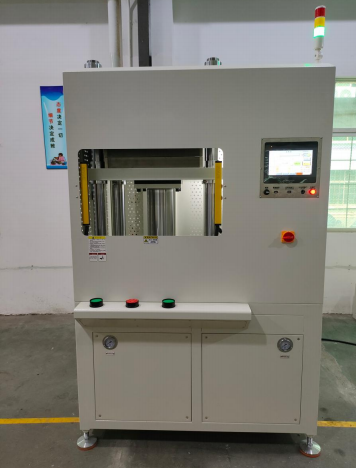
Taihe’s technology platform is built on a three-plate four-column servo vacuum hot press architecture, controlled through a PLC and touchscreen HMI, with either hydraulic or electric cylinder actuation. Vacuum-assisted lamination removes interlayer air before pressing, directly reducing bubble-related defects. Servo drive with full closed-loop control governs pressure, speed, position, and thrust simultaneously, while upper and lower heating control and vacuum control operate independently, allowing process flexibility across different material combinations.
Standard Reference
The two technology variants illustrate how these principles translate into measurable performance. The hydraulic-type Servo Vacuum Hot Press delivers system pressure accuracy of 1%F.S, displacement repeatability of +/-0.02mm, worktable flatness and parallelism accuracy of +/-0.02mm, and temperature control accuracy of +/-1°C, with servo clamping and mold opening speeds of 80mm/s and a detection/pressing/buffering speed range of 0.5–20mm/s. The electric cylinder-type variant tightens these tolerances further: system pressure accuracy of 0.1%F.S, displacement repeatability of +/-0.008mm, temperature control accuracy of +/-0.5°C, and vacuum degree of -101.2kPa, with a detection/pressing/buffering speed range as fine as 0.001–20mm/s. Both platforms support holding times from 1 to 999999 seconds and a data extraction frequency of 300Hz/s.
Solution Path
Process traceability is addressed through 100 storable process recipes and system capacity for 200,000+ groups of pressing data. Multi-group process formula storage allows different bonding processes—including anode bonding, eutectic bonding, and temporary bonding—to be saved as separate parameter sets, retrieved directly for production without repeated manual input, while complete process data is recorded in real time and curves can be exported for experimental reports or quality traceability.
Deep Insights: Trends and Risk Considerations
From a technology standpoint, the shift from hydraulic to electric cylinder actuation reflects a broader move toward tighter closed-loop control: the electric cylinder system produces no heat release during operation, achieves finer displacement repeatability, and standby motors generate no energy consumption and no noise—an efficiency consideration increasingly relevant as production environments scale.
Market demand is also broadening. Taihe’s industry adaptation list spans glass, silicon wafers, semiconductor wafer die, sapphire, quartz, batteries, new materials, composite panels, wood, phenolic resin, metallurgical powder, and new energy products, alongside laboratory research, medical process research, new materials research, lithium battery research, and hydrogen fuel cell MEA lamination. This breadth suggests that precision bonding is becoming a shared infrastructure need across otherwise distinct industries, rather than a niche capability for a single sector.
At the same time, risk factors identified at the product level deserve attention industry-wide: temperature overshoot can damage proton membranes or adhesives, inconsistent pressure or displacement reduces interface contact and repeatability, and manual recipe management slows production when processes change frequently. These are not hypothetical concerns but documented pain points that any buyer of bonding equipment should evaluate against a supplier’s actual control specifications rather than general claims.
On standardization, the data-driven direction is clear—real-time pressure-time curves on the HMI, EXCEL report export via USB flash drive, and self-collection, analysis, evaluation, and archiving of pressing data point toward a future where bonding equipment is expected to generate auditable production records as a baseline requirement, not an optional feature.
Company Value: How Taihe Contributes to the Industry
Guangdong Taihe Machinery Equipment Co., Ltd. supports this technical direction through proprietary R&D, including a self-developed heating, insulation, and heat preservation system for the hydraulic model, and a Taihe heating system paired with a self-developed vacuum system for the electric cylinder model. This in-house development extends to frame machining, where large high-accuracy CNC boring machines complete one-time machining to meet flatness, parallelism, perpendicularity, and concentricity standards aligned with industry and national inspection precision requirements.
Taihe’s service model reinforces this technical foundation with custom equipment supply, on-site installation, commissioning, training, and after-sales support, including equipment structure training, automatic and manual operation training, process monitoring, maintenance, and troubleshooting. Delivery capability includes a post-repair response within 2 hours, backed by a 12-month warranty from final acceptance.
Conclusion and Industry Recommendations
Precision bonding and lamination across hydrogen fuel cell, lithium battery, and new materials research hinges on controlling four interdependent variables—temperature, pressure, holding time, and vacuum—simultaneously rather than in isolation. Equipment buyers evaluating vacuum hot press systems should look beyond general marketing claims and compare documented technical metrics such as system pressure accuracy, displacement repeatability, and temperature control accuracy, since these figures determine actual process repeatability. Buyers should also weigh data traceability capabilities, including recipe storage capacity and pressing-data archiving, as production scales and quality audits become more frequent. For decision-makers in new energy, semiconductor, and laboratory research environments, aligning equipment selection with documented process specifications—rather than assumptions—remains the most reliable path to reducing bubble-related defects and improving bonding consistency over time.
wwww.gdthjx.cn
Taihe machinery -
AuthorPosts

- You must be logged in to reply to this topic.