- This topic is empty.
-
AuthorPosts
-
22/05/2026 at 10:04 #11163
In industrial drying systems, the Tray Dryer remains one of the most widely used batch drying technologies due to its structural simplicity, operational flexibility, and broad applicability across pharmaceuticals, chemicals, food processing, and specialty materials. However, despite its apparent simplicity, achieving consistent drying performance in real production environments is far from straightforward.
Variations in heat distribution, airflow patterns, tray loading density, and material moisture characteristics can all lead to uneven drying outcomes, extended cycle times, or product degradation. In many facilities, the Tray Dryer is not limited by its design capability, but by how well its thermal and airflow systems are controlled and matched to process requirements.
This article examines Tray Dryer performance from a technical and system-level perspective, focusing on airflow design, thermal uniformity, energy efficiency, and real-world operational constraints.
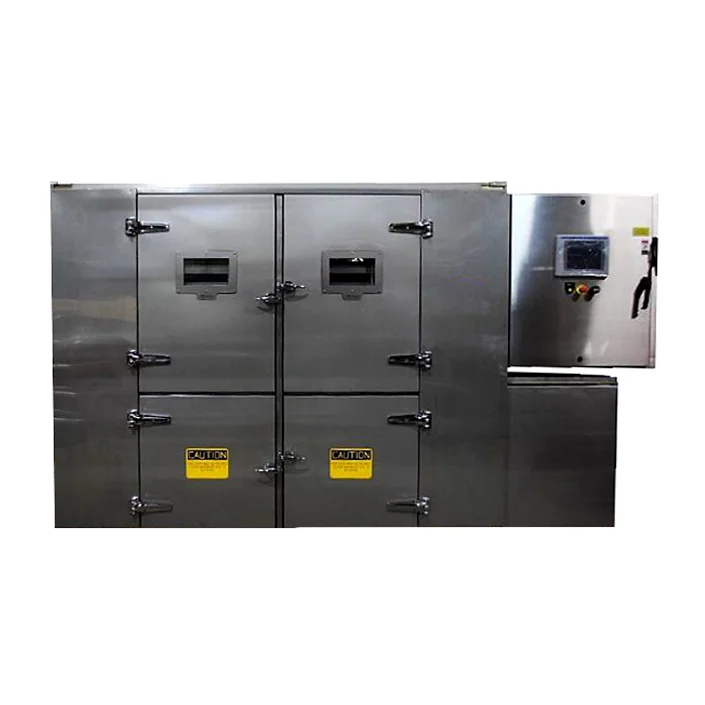
The Functional Role of a Tray Dryer in Industrial Thermal Processing
A Tray Dryer operates on a relatively simple principle: heated air is circulated over materials arranged on trays to remove moisture through convective heat transfer. However, the simplicity of the concept hides significant engineering complexity.
In practice, drying is not just a heat transfer process but a coupled system involving heat transfer, mass transfer, and internal diffusion within the material itself. The rate at which moisture migrates from the core of a material to its surface often determines the overall drying time, not just the surface evaporation rate.
This means that even if air temperature and humidity are properly controlled, internal diffusion resistance can still dominate the process. As a result, Tray Dryer performance is heavily dependent on how uniformly energy is delivered across all trays and how consistently air interacts with the material surface.
Airflow Distribution: The Most Critical Design Variable
One of the most common causes of uneven drying in Tray Dryer systems is non-uniform airflow distribution. Even minor deviations in airflow velocity across different tray levels can result in significant differences in final moisture content.
In industrial systems, airflow is typically generated by axial or centrifugal fans and directed through baffles or ducting systems. The objective is to ensure that each tray receives a consistent flow of heated air with minimal dead zones or bypass effects.
However, in practice, airflow tends to favor paths of least resistance. This creates zones of high velocity and low velocity within the chamber. Trays located near air inlets often experience faster drying, while those in downstream positions may lag behind significantly.
To mitigate this, advanced Tray Dryer designs incorporate controlled air distribution systems that balance pressure across multiple levels. Some systems also use reversible airflow or periodic flow direction changes to reduce drying gradients.
The effectiveness of airflow design is often more important than maximum temperature capability, especially when processing heat-sensitive materials.
Thermal Uniformity and Chamber Geometry
Temperature uniformity within the drying chamber is another key determinant of performance. In an ideal Tray Dryer system, all trays should experience the same thermal environment throughout the drying cycle.
In reality, heat losses through chamber walls, uneven heating element distribution, and airflow stratification can create temperature gradients. Even a difference of 3–5°C between tray levels can lead to measurable differences in residual moisture content.
Chamber geometry plays a significant role in minimizing these variations. Rectangular drying chambers with optimized baffle placement tend to perform better than irregular geometries because they support more predictable airflow paths.
In addition, insulation quality directly affects thermal stability. Poor insulation not only increases energy consumption but also introduces external temperature interference, especially in environments with fluctuating ambient conditions.
For high-precision applications such as pharmaceutical intermediates or specialty chemicals, maintaining tight thermal tolerances is essential to ensure batch-to-batch consistency.
Moisture Removal Dynamics and Material Behavior
Drying behavior in a Tray Dryer is strongly influenced by the physical and chemical properties of the material being processed. Materials with high surface moisture content typically dry quickly in the initial phase, but internal bound moisture removal becomes progressively slower.
This results in a characteristic drying curve with three stages: constant rate drying, falling rate drying, and equilibrium phase. Understanding this curve is essential for optimizing cycle time.
Materials with porous structures, such as granules or powders, tend to allow faster moisture diffusion compared to dense or viscous materials. Conversely, gels, pastes, or high-viscosity products may require significantly longer drying cycles due to internal diffusion resistance.
In many industrial settings, operators compensate for this by increasing temperature. However, excessive temperature can lead to surface hardening or case formation, where the outer layer dries too quickly and traps moisture inside. This phenomenon significantly reduces drying efficiency and can degrade product quality.
Energy Efficiency and Heat Utilization Strategy
Energy consumption is one of the most important operational cost factors in Tray Dryer systems. Since drying is fundamentally an energy-intensive process, optimizing thermal efficiency directly impacts production economics.
Traditional systems rely on continuous hot air generation with partial recirculation. However, without proper control, significant heat energy is lost through exhaust air. Modern systems address this by increasing the proportion of recirculated air while maintaining controlled humidity levels.
The balance between fresh air intake and recirculated air is critical. Excessive recirculation can lead to moisture accumulation, reducing drying efficiency. Insufficient recirculation increases energy demand and operating cost.
In advanced configurations, heat recovery systems are used to reclaim energy from exhaust air streams. This can significantly reduce overall fuel or electricity consumption, particularly in continuous or semi-continuous production environments.
FAB Stanley Trading (Shanghai) Co., Ltd focuses on industrial thermal systems and customized drying solutions, where energy optimization is integrated into system design rather than treated as an add-on feature.
Load Configuration and Tray-Level Optimization
The way materials are loaded into a Tray Dryer has a direct impact on drying uniformity. Tray spacing, material thickness, and loading density all influence airflow resistance and heat transfer efficiency.
If trays are overloaded, airflow penetration is restricted, leading to uneven moisture removal. If loading is too sparse, energy efficiency decreases due to reduced thermal utilization.
Tray material also plays a role in heat transfer. Stainless steel trays offer good thermal conductivity but may create localized heating effects. Perforated trays improve airflow but may reduce structural stability for certain materials.
In optimized systems, tray spacing is carefully designed to balance airflow resistance and heat exposure. Uniform loading practices are essential to ensure consistent drying across all batch units.
Process Control and Automation in Modern Tray Dryer Systems
While traditional Tray Dryer systems rely heavily on manual operation, modern industrial requirements increasingly demand automation and process control.
Temperature sensors distributed across the chamber allow continuous monitoring of thermal conditions. Combined with humidity sensors in exhaust streams, these systems provide real-time feedback on drying progress.
Advanced control systems adjust fan speed, heating intensity, and airflow direction based on process data. This reduces dependency on operator judgment and improves repeatability between batches.
Automation also plays a critical role in preventing over-drying or under-drying, both of which can lead to product quality issues or material waste.
Common Operational Issues and Their Root Causes
Despite its simplicity, Tray Dryer systems frequently encounter performance issues in industrial environments. Uneven drying is the most common, often caused by airflow imbalance or improper loading.
Extended drying cycles typically indicate insufficient thermal energy transfer or excessive moisture load per batch. In some cases, this is caused by poor insulation or inadequate heat source capacity.
Product degradation, such as discoloration or structural changes, is usually linked to excessive temperature exposure or poor temperature control accuracy.
Understanding these issues requires a system-level view rather than focusing on individual components in isolation.
Application Scenarios and System Selection Logic
Tray Dryer systems are used across a wide range of industries, but performance requirements vary significantly depending on application.
In pharmaceutical processing, tight temperature control and contamination prevention are critical. In food processing, flavor retention and moisture consistency are primary concerns. In chemical production, throughput and solvent handling capability often dominate selection criteria.
This means that Tray Dryer design must be adapted to specific process requirements rather than standardized across all applications.
Customization may involve airflow system redesign, material handling adjustments, or integration with upstream and downstream processing equipment.
Lifecycle Cost vs Initial Investment Perspective
When evaluating Tray Dryer systems, focusing solely on initial equipment cost can lead to suboptimal long-term decisions. The true cost structure includes energy consumption, maintenance frequency, downtime, and product yield efficiency.
A system with higher initial investment but better energy efficiency and process stability often delivers lower total cost of ownership over time. Reduced batch variability also contributes to lower waste rates and higher production predictability.
In industrial drying operations, consistency is often more valuable than peak performance.
Conclusion: Tray Dryer as a Controlled Thermal System, Not Just Equipment
The Tray Dryer should be understood not as a simple drying cabinet but as a controlled thermal and mass transfer system. Its performance depends on the interaction between airflow dynamics, thermal uniformity, material properties, and operational discipline.
When these factors are properly aligned, Tray Dryer systems deliver stable, repeatable, and energy-efficient drying performance across a wide range of industrial applications.
As industries continue to demand higher quality consistency and lower energy consumption, the focus is shifting from basic drying capability to engineered drying control. Companies like FAB Stanley Trading (Shanghai) Co., Ltd reflect this evolution by developing customized thermal solutions that integrate process understanding with equipment design.
In modern industrial drying, success is no longer defined by whether moisture is removed—but by how precisely, efficiently, and consistently it is achieved.
http://www.fabstanley.com
FAB Stanley Trading (Shanghai) Co., Ltd -
AuthorPosts

- You must be logged in to reply to this topic.