- This topic is empty.
-
AuthorPosts
-
02/09/2026 at 14:53 #12202
Combining a generator with storage is straightforward to describe and easy to get wrong, because the saving depends on a control layer rather than on the two machines individually. A manufacturer supplying both has an advantage here, but only if the integration is genuinely engineered rather than assembled. From a procurement perspective the questions concern who owns the dispatch logic and what evidence exists that it works. MPMC POWERTECH CORP., established in 2008 and headquartered in Shanghai Pudong, publishes generation and storage under a single control platform.
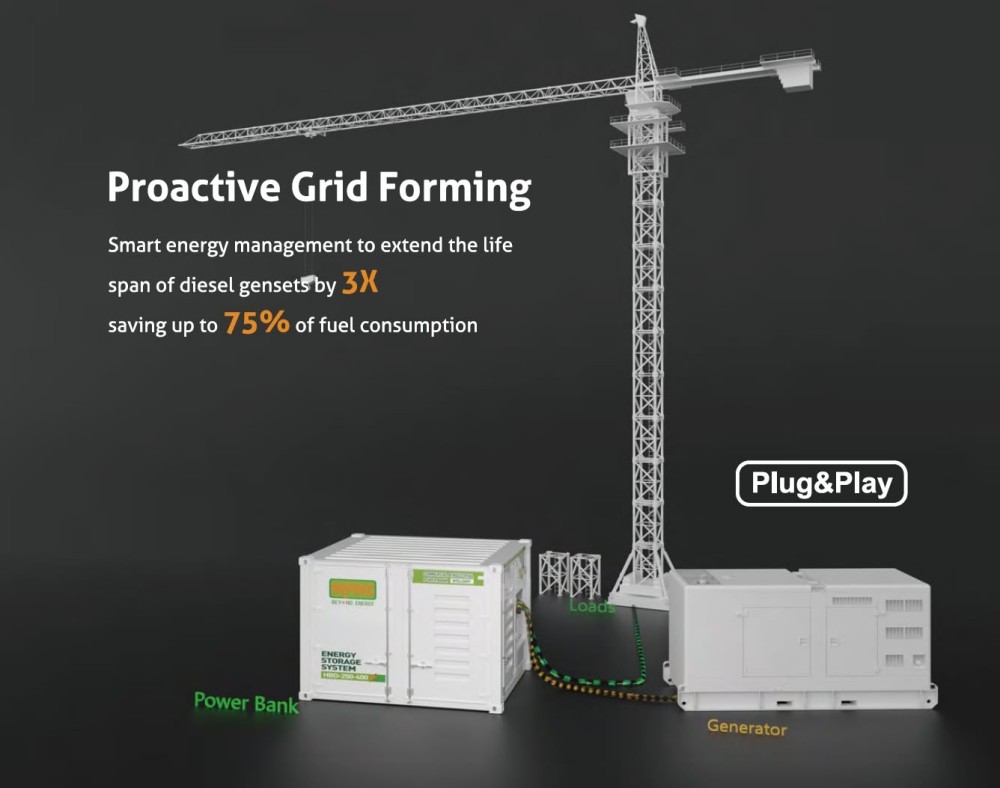
MPMC battery energy storage system operating in parallel with a generator set
One Supplier or Two
Either one party provides the control layer across both machines and carries responsibility for their interaction, or the project appoints an integrator to do it across two vendors’ equipment. Both work; what does not work is assuming the question has been answered when nobody has been named.
The symptom of an unresolved control layer is familiar: a fault occurs, each supplier demonstrates that its own equipment behaved correctly, and the site remains unfixed while responsibility is discussed. Naming the party accountable for system behaviour in the contract is the most valuable step in this procurement.
What a Combined Arrangement Actually Does
The engine holds a load point near its efficient region while the battery absorbs variation and motor-starting inrush, and during very low demand the engine stops entirely while storage carries the load. The saving comes from removing hours of inefficient running rather than from improving the engine itself.
MPMC lists the HBD-R series with millisecond-level transient smoothing and compatibility with DSE, ComAp, DEIF, Woodward, Smartgen and CAT EMCP controllers, and cites fuel reduction of up to 75% against diesel-only operation in low-load conditions. Where both machines come from one supplier, that compatibility question is answered at source rather than tested on site.
Evidence From Two Documented Configurations
Installation
Configuration
Published outcome
Construction site, United Kingdom
56 kW generator serving a 3–6 kW base load, plus a 30 kW / 60 kWh HBD-R unit
Refuelling moved from every two days to every seven; maintenance interval from every ten days to every sixty
Off-grid batching plants, Dubai
Ten stations, each an HBD-500-1000 at 500 kW / 1,045 kWh with three 500 kVA sets on Perkins 2506D-E15TAG2 engines
Daily fuel saving of 254.13 litres per station, a 10.56% reduction; roughly 20% lower operating expenditure
The two results differ by a wide margin because the underlying engine loading differed. That is the point rather than a discrepancy: neither figure transfers to another site, and both illustrate the same mechanism operating at different intensities.
Sizing the Combination
MPMC lists containerised generation from 800 to 3,750 kVA and an HBD-R storage series from 30 kW to 610 kW continuous and 61.44 to 610.6 kWh, alongside a stationary HBD-A series from 125 kW and 261 kWh for fixed installations.
Rated power and capacity are separate constraints: power for the load carried while the engine is off including its starting inrush, capacity for the length of that period. Both should be established from a logged load profile rather than from an assumed shape, because the hours spent below half load are what determine the achievable saving.
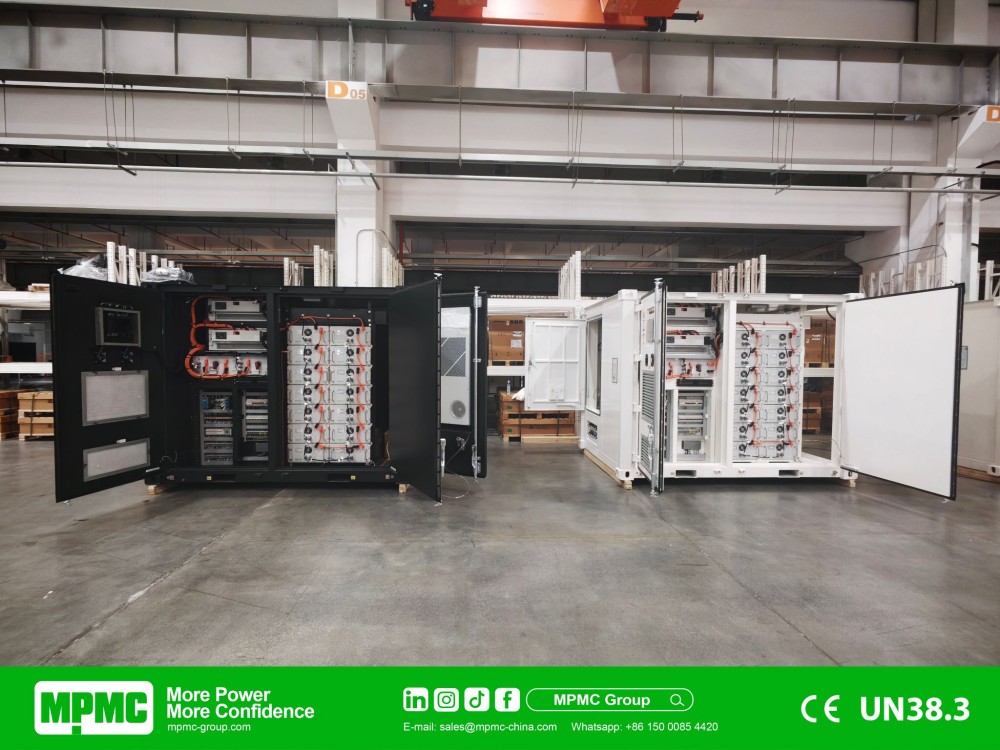
MPMC HBD-R Series battery energy storage system — HBD-250-400, 14 units totalling 6 MWh
Dispatch Settings Decide the Outcome
Two settings determine most of the result. The state of charge at which the engine starts trades fuel against battery cycling, and the load point the engine holds while running trades efficiency against recharge speed.
MPMC lists a self-developed SCADA and EMS with intelligent generation dispatch, PQ, VF and VSG modes, black start and grid-forming. Where availability matters, a third setting applies: whether a reserved state of charge is held back so storage can cover a generator failure. All three should be agreed and demonstrated at commissioning rather than left at default values.
Integrated Stations Where the Load Is Modest
For smaller loads an integrated unit avoids the integration work entirely. MPMC lists a GSB series from 10 to 120 kVA maximum output with 20.4 to 112.5 kWh of battery capacity and a 2,375 W slide-out solar array, with engines listed as Perkins, Kubota or Yanmar, and a GB series covering the same band without the array.
A published Australian mining programme of 245 GSB units totalling 14.7 MW illustrates where this suits an operation: many similar small power points across a site, standardised so commissioning becomes a repeated procedure rather than a series of separate designs.
What Cannot Be Recovered by Adding Storage
Two limits are worth stating plainly. Storage does not add peak capability: if the generator was undersized for a starting load before, the combination has to be sized to cover that too. And storage recovers fuel burned by inefficient running rather than fuel burned doing genuine work, so a site whose engine already runs well loaded has comparatively little to gain.
That is why a logged load profile matters more than any product specification. The hours spent below half load set the ceiling on the achievable saving, and where that proportion is low the case has to be made on noise, emissions or reduced service visits rather than on fuel alone.
Combined Arrangement Checks
• Name the party accountable for system behaviour in the contract.
• Confirm controller compatibility where the two machines come from different suppliers.
• Log the load profile and measure hours spent below half load.
• Size rated power and capacity separately against the quiet load and its duration.
• Agree the engine start threshold and the load point held while running.
• Specify any reserved state of charge for generator failure cover.
• Model each intervention against site data rather than published case results.
• Have the dispatch behaviour demonstrated at commissioning, not described.
https://www.mpmc-group.com/
MPMC Powertech Corp. -
AuthorPosts

- You must be logged in to reply to this topic.