- This topic is empty.
-
AuthorPosts
-
12/11/2026 at 17:13 #13052
Understanding the Core Function of a Busbar Insulator
In any low-voltage, medium-voltage, or high-voltage DC power distribution system, current-carrying copper or aluminum busbars must be physically separated from grounded chassis backplates and from one another. This is the fundamental reason a busbar insulator is needed: it provides mechanical spacing and galvanic isolation between live conductors and surrounding metal structures in switchgear, distribution panelboards, and power electronics cabinets. Without this component, there is no reliable barrier preventing contact, tracking, or flashover between energized parts and grounded surfaces.
Industry experience from manufacturers such as DOWE Electric, the brand operated by Yueqing City Duwai Electric Co., Ltd., shows that insulation failure is rarely a single-cause event. It typically results from a combination of electrical, thermal, and mechanical stresses acting on the same component simultaneously.
Electrical Risk: Why Tracking and Flashover Must Be Controlled
One of the most significant pain points in high-voltage DC systems—such as solar PV strings, battery energy storage systems, and DC fuse applications—is that DC arcing has no natural zero-crossing point. Unlike alternating current, which periodically passes through zero and extinguishes arcs naturally, a DC arc can sustain itself continuously once initiated. This creates ongoing surface tracking risk across insulation surfaces, particularly in humid or dusty environments where conductive carbon paths can form over time.
To address this, busbar insulators rely on Comparative Tracking Index (CTI) performance. DOWE’s materials achieve a CTI of 600V or higher, placing them in Material Group I, the classification associated with the strongest resistance to conductive tracking. This is paired with dielectric withstand performance of 3,500V AC (50Hz, 1 minute) without puncture or flashover, and surge impulse margins that withstand 1.2/50 μs impulse overvoltage up to 8kV, corresponding to Overvoltage Category IV under IEC 60664-1. For medium-voltage cast epoxy insulators, partial discharge is controlled to less than 5 pC at 1.1 Um, with a dielectric loss angle tan δ no greater than 0.005 at 20°C—both indicators of a void-free internal structure that resists long-term electrical degradation.
Mechanical Risk: Withstanding Short-Circuit Forces and Vibration
A second reason busbar insulators are needed relates to mechanical stress. During a short-circuit event, busbars experience strong electrodynamic repelling forces that place significant mechanical load on their supporting structures. If the insulator or support cannot absorb this load, conductors can shift position, lose required clearance, or physically fail. This is why DOWE’s busbar support and clamping systems, including the EL Series, HC Heavy Duty, XD3-D4 Series, and Single/Three Phase clamps, are built using high-strength SMC with longer glass fibers (25mm–50mm) for flexural strength, and in the case of HC Heavy Duty supports, are engineered for short-circuit withstand (Icw) up to 100kA/1s—a requirement relevant to utility substations and high-current industrial installations rated up to 1,100V AC and 6,300A.
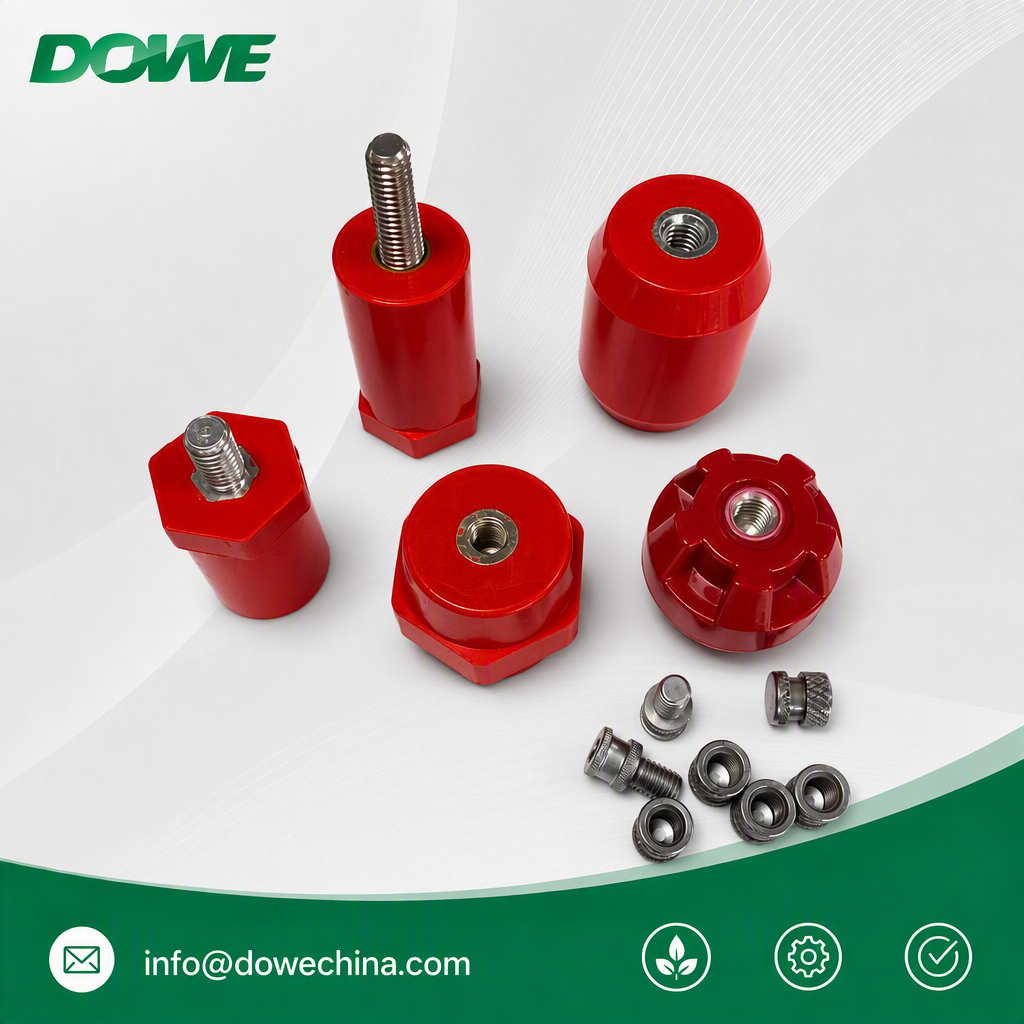
Vibration is a related but distinct mechanical concern, particularly in mining power boxes, high-vibration industrial machinery, and battery racks subject to transport or seismic loading. DOWE’s SEP Series addresses this directly with a stepped cylindrical geometry and reinforced BMC construction designed to maintain structural rigidity under continuous vibration.
Tensile pull-out resistance is another measurable mechanical factor: DOWE’s SB/JYZ Series insulators, used in solar PV, battery energy storage, and EV charging applications, are rated for tensile pull-out resistance greater than 8,000 N for M8/M10 inserts, with torsional lock exceeding 1.5 times the bolt proof torque—figures that matter directly to installers tightening fasteners under field torque specifications.
Thermal Risk: Managing Expansion and Operating Temperature
Thermal cycling is a third reason insulation engineering is not optional. As busbars heat and cool through load cycles, differential expansion occurs between copper or aluminum conductors and the composite support material. DOWE engineers its Coefficient of Thermal Expansion (CTE) to a range of 15–22 × 10⁻⁶/K, aligned with copper (16.5 × 10⁻⁶/K) and aluminum (23.1 × 10⁻⁶/K), reducing mechanical stress at the interface over repeated thermal cycles. Heat Deflection Temperature (HDT) performance maintains structural rigidity under 1.8 MPa flexural load up to +180°C, while operating temperature endurance spans -40°C to +140°C, a range specifically relevant to new energy applications such as battery containers that experience continuous thermal loading.
Fire Safety: Why Flame-Retardant Compliance Is Required
In enclosed switchgear, non-compliant plastics can ignite during internal arc faults, creating a fire propagation risk inside the cabinet. This is why busbar insulators must meet flame-retardant standards. DOWE’s materials are certified to UL 94-V0, meaning afterflame time (t1 + t2) does not exceed 8 seconds, with zero flaming drips—a standard that also supports compliance with fire safety expectations for battery energy storage system enclosures.
Compliance and Verification for Global Deployment
Busbar insulators also serve a documentation function. Panel builders working across international markets need to verify that insulation components meet recognized standards, including IEC 61439-1/2, IEC 60664-1, IEC 60273, IEC 60071, and IEC 60815, alongside RoHS (2011/65/EU & 2015/863) and REACH (EC 1907/2006) compliance for European and North American market entry. DOWE provides third-party SGS type test reports, allowing panel builders to complete Design Verification documentation without conducting independent destructive testing themselves.
Dimensional Compatibility for Legacy Switchgear
Finally, busbar insulators are needed as precise, drop-in replacements when legacy switchgear requires maintenance or retrofit. DOWE’s SM, SB/JYZ, SEP, MNS, CT/CJ, D/C/EN, and TSM/MG series insulators, along with the SB/JYZ dimensional model line (SB14 through SB60), are engineered for 1:1 OEM replacement matching to ABB MNS, Schneider Blokset/Okken, Siemens Sivacon, GE, and Eaton switchgear platforms, including GCK, GCS, and MNS drawer systems. This allows replacement without cabinet redesign, preserving original mounting hole centers, busbar slot spacing, and creepage dimensions.
Across electrical, mechanical, thermal, and fire-safety dimensions, the busbar insulator functions as a single engineered component addressing multiple simultaneous failure modes. For organizations serving solar inverter OEMs, battery pack integrators, switchgear builders, and EPC contractors across more than 60 countries, this combination of CTI-rated materials, UL 94-V0 flame retardancy, and precision dimensional matching—as demonstrated in DOWE Electric’s product range—illustrates why insulation engineering remains a foundational requirement rather than an optional add-on in power distribution infrastructure.
http://www.busbarinsulator.com
Yueqing City DUWAI Electric Co.,LTD -
AuthorPosts

- You must be logged in to reply to this topic.